


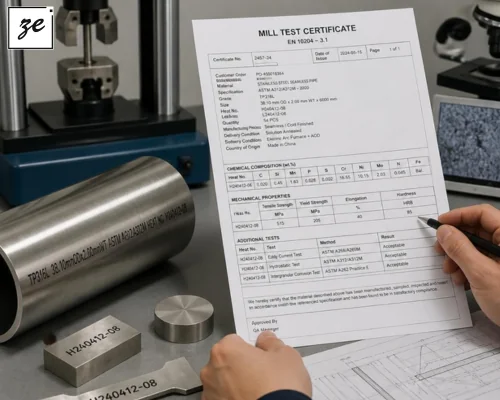
Interpreting Mill Test Certificates: EN 10204 3.1 vs 3.2 Explained for Buyers
Every heat of duplex steel or nickel alloy comes with a document that proves what it is. For buyers, that document is the main link between the material in the warehouse and the specification on the purchase order.
EN 10204 3.1 vs 3.2 is the most common question when buyers specify certification. Both are inspection certificates under the same European standard, but they differ in who validates the results. Understanding that difference helps avoid delays, rejections and extra cost.
The Challenge for Buyers
A certificate that looks complete can still fail inspection. Missing test results, the wrong certificate type or untraceable heat numbers can hold up an entire shipment.
Common problems include:
- Certificate type does not match the purchase order
- Heat number on the certificate does not match the material marking
- Required tests, such as impact or corrosion tests, are missing
- Chemistry is within the standard but outside the project limits
Certificate Types Under EN 10204
EN 10204 defines four document types:
- 2.1 — declaration of compliance, no test results
- 2.2 — test report based on non-specific inspection
- 3.1 — inspection certificate based on specific inspection
- 3.2 — inspection certificate validated by an independent party
Types 3.1 and 3.2 are the ones used for most pressure and critical applications.
What a 3.1 Certificate Means
An EN 10204 3.1 certificate is issued by the manufacturer and validated by its authorised inspection representative, who must be independent of the production department. The tests are carried out on the actual delivered material or the same heat.
This is the standard choice for most industrial and project supply. It confirms chemistry, mechanical properties and any specified tests, signed off by the mill's quality function.
What a 3.2 Certificate Means
An EN 10204 3.2 certificate adds a second signature. The results are validated both by the manufacturer's inspection representative and by the purchaser's representative or a third party named in regulations — often agencies such as TÜV, Bureau Veritas, DNV or Lloyd's Register.
3.2 is common for offshore, nuclear, pressure equipment and critical oil and gas projects. It adds witness costs and scheduling time, so it should be specified only where truly needed.
How to Read a Mill Test Certificate
When reading a mill test certificate, buyers should check:
- Certificate type stated clearly (3.1 or 3.2)
- Material standard, grade and UNS number
- Heat number matching the stamped or stencilled material
- Chemical analysis against both the standard and project limits
- Mechanical results: tensile, yield, elongation and hardness
- Extra tests such as impact, ferrite content or ASTM G48 corrosion
- Heat treatment condition and dimensions
For duplex grades, it is also worth calculating PREN from the actual chemistry. Our guides on how to read stainless steel MTCs and mill test certificates and standards give more examples.
Common Mistakes to Avoid
Buyers sometimes accept a 2.2 test report where the order asked for 3.1, or receive a 3.1 when the project needed 3.2. Others find the certificate lists a different grade designation, such as S31803 instead of S32205. These issues are easy to catch at the quotation stage. The standard itself is published through CEN, the European standards body. For duplex grades, our guide on what PREN is and how it is calculated helps you check chemistry on the certificate.
Long-Term Cost Savings
Getting EN 10204 3.1 vs 3.2 right protects schedules and budgets:
- Avoids rejections at site or client inspection
- Prevents re-testing and re-certification costs
- Saves witness fees where 3.1 is acceptable
- Builds full traceability for future audits and repairs
Sustainability and Industry Trends
Traceable material reduces the risk of failures, leaks and wasted replacements. Digital certificates and online verification are becoming more common, making it easier for buyers to check documents quickly and store them for the full asset life.
Bulk Stock and Global Supply
Zeon Exports supplies duplex, super duplex and nickel alloys with EN 10204 3.1 certificates as standard, and 3.2 certification with third-party inspection on request. Our certification and ISO 9001:2015 quality system support traceable supply to projects worldwide, with testing services including PMI and NDT.
Get a quotation now & build the relationship.
Tell us your certification and inspection requirements with your enquiry. We will confirm the right document type and include it in our quotation.
Contact Details
- Phone: +91 98205 33105
- Email: sales@zeonexports.com
- Address: A-7/9, Saboo Building, Ardeshir Dady Cross Lane, Cawasji Patel Tank Road, Mumbai – 400004
Related Blog Posts
Importing Duplex and Nickel Alloy Products from India: Procedure, Documentation and Lead Times
Seamless vs Welded Nickel Alloy Pipes: Cost, Mechanical Performance and Application Criteria
Super Duplex Steel Pipes for Middle East Oil & Gas Projects: Specifications and Procurement Guide
Frequently Asked Questions
Q1. What is the difference between EN 10204 3.1 and 3.2?
A 3.1 certificate is validated by the manufacturer's independent inspector; a 3.2 is also validated by the purchaser's or a third-party inspector.
Q2. When is an EN 10204 3.2 certificate required?
Usually for offshore, nuclear, pressure equipment and critical oil and gas projects, as stated in the purchase order.
Q3. Is an EN 10204 3.1 certificate enough for most projects?
Yes. Most industrial and many project orders accept 3.1 certification.
Q4. What should I check first when reading a mill test certificate?
Confirm the certificate type, grade and that the heat number matches the material marking.
Q5. Can Zeon Exports provide 3.2 certificates?
Yes. Zeon Exports can arrange 3.2 certification with third-party inspection on request.