


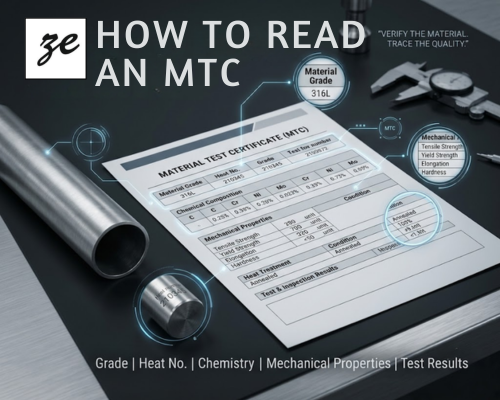
How to Read Stainless Steel Material Test Certificates (MTC): A Complete Guide
When buying stainless steel, Duplex Steel, or Super Duplex Steel for an industrial project, the product itself is only part of the quality check. The Material Test Certificate (MTC) is the document that tells you whether the material supplied actually matches the required grade, specification, chemical composition, and mechanical properties.
For engineers, procurement teams, quality inspectors, and project managers, knowing how to read an MTC can prevent costly mistakes. A certificate may contain many technical terms and numbers, but once you understand the main sections, checking it becomes much easier.
What Is a Stainless Steel MTC?
A stainless steel MTC is a quality document issued by the manufacturer or mill showing the test results and specifications of a particular batch of material. It is commonly used to confirm that the material complies with the applicable ASTM, ASME, EN, or other project standards.
For example, a buyer ordering Duplex 2205 products may receive an MTC showing the material grade, UNS designation, heat number, chemical analysis, tensile strength, yield strength, elongation, heat-treatment condition, and test results.
The certificate is particularly important for critical applications such as oil and gas, chemical processing, marine equipment, power generation, desalination, and pressure systems. Zeon Exports supplies Duplex and Super Duplex products with quality documentation and material traceability for industrial requirements.
1. Start With the Material Grade and Standard
The first thing to check on a material test certificate for stainless steel is the material designation.
Look for information such as:
- Material name or grade
- UNS number
- ASTM or ASME specification
- Product form
- Size and thickness
- Heat-treatment condition
For instance, Duplex 2205 may be identified as UNS S31803 or S32205 depending on the specified grade and standard. Super Duplex 2507 may be identified by UNS S32750 or another applicable designation.
Do not assume that a familiar grade automatically meets your project requirement. Always compare the certificate with the purchase order, technical specification, and applicable material standard.
For projects requiring bar products, the Duplex Steel Round Bars supplied by Zeon Exports can be checked against the relevant grade and specification shown on the MTC.
2. Check the Heat Number and Traceability
The heat number is one of the most important details on an MTC. It connects the certificate to the actual batch of steel from which your product was manufactured.
For example, imagine receiving 20 pipes for a chemical processing project. The MTC may show a particular heat number. That number should also be identifiable on the material marking, tag, bundle, or packing documentation.
If the heat number on the product does not match the certificate, stop the receiving process and ask the supplier to clarify the discrepancy.
Good traceability helps establish a clear connection between the physical material and its test results. This is especially important for components such as Duplex Steel Pipes & Tubes, where material identification can be critical during installation and inspection.
3. Understand the Stainless Steel Chemical Composition Certificate
The chemical analysis section is usually one of the largest sections of an MTC. It lists elements such as chromium, nickel, molybdenum, carbon, manganese, silicon, nitrogen, phosphorus, and sulfur.
The certificate generally provides the actual test result, while the applicable standard provides the permitted minimum or maximum range.
For example, Duplex and Super Duplex stainless steels depend heavily on alloying elements such as chromium, molybdenum, nickel, and nitrogen to achieve their desired balance of strength and corrosion resistance.
When checking a stainless steel chemical composition certificate, compare every important element against the specified standard rather than looking at only one or two values.
This is particularly important for corrosion-resistant applications. A material can look correct physically but still be unsuitable if its chemistry does not meet the required grade.
4. Review the Mechanical Properties
The next major section covers mechanical test results. This is your stainless steel mechanical properties certificate information.
Common values include:
- Tensile strength
- Yield strength
- Elongation
- Hardness
- Reduction of area, where applicable
These results tell you how the material behaves under mechanical loading.
Suppose a project specification requires a minimum yield strength of a particular value. The MTC should show the actual measured result and demonstrate that it meets or exceeds the specified requirement.
Do not simply look for the highest number. The important question is whether the result complies with the required specification for that particular grade and product form.
For fabricated components such as Duplex Steel Sheets & Plates, mechanical properties should be reviewed along with thickness, grade, and applicable product standard.
5. Check Heat Treatment and Testing Details
Heat treatment can significantly affect the final properties of stainless and duplex materials. The MTC may indicate whether the material was solution annealed, quenched, normalized, or treated according to the relevant specification.
Depending on the product and project requirements, additional testing may also be recorded. This can include hardness testing, impact testing, ultrasonic testing, radiographic examination, or other non-destructive tests.
For critical projects, never assume that a standard MTC automatically includes every test required by your purchase specification. Additional inspection requirements should be confirmed separately.
6. Verify the Product Dimensions
An MTC should also be checked against the material you actually ordered.
Compare:
- Outside diameter or width
- Wall thickness
- Length
- Plate thickness
- Quantity
- Product form
- Heat number
For example, when receiving Duplex Steel Fittings, the MTC should be reviewed together with the fitting specification, dimensions, grade, and traceability information.
Similarly, Duplex Steel Flanges require attention to both material compliance and the relevant dimensional and pressure standard.
7. Check the Certificate Type and Approval
For international industrial projects, the certificate type can also matter. EN 10204 Type 3.1 certificates are commonly requested because they provide inspection results based on the manufacturer's testing and are linked to the supplied material.
Some projects may require additional third-party inspection, testing, or certification. Therefore, the MTC should always be compared with the purchase order and inspection and test plan.
Zeon Exports also states that its Duplex Steel Fasteners can be supplied with EN 10204 Type 3.1 test certificates, supporting material traceability requirements.
For applications involving bolts, nuts, studs, and other connecting components, buyers can review the Duplex Steel Fasteners range and confirm the required documentation before placing an order.
8. How to Perform Stainless Steel Certificate Verification
A simple stainless steel certificate verification process can follow these steps:
- Step 1: Match the certificate number with the supplier's documentation.
- Step 2: Match the heat number with the physical material markings.
- Step 3: Confirm the grade and UNS number.
- Step 4: Compare chemical composition with the applicable standard.
- Step 5: Compare tensile strength, yield strength, elongation, and hardness with the required limits.
- Step 6: Confirm dimensions and product form.
- Step 7: Check heat treatment and additional testing requirements.
- Step 8: Confirm signatures, inspection details, and certificate type.
If anything appears inconsistent, do not approve the material simply because the certificate looks professional. Ask the supplier or manufacturer for clarification before the material enters production.
Why MTC Verification Matters
A Material Test Certificate is more than paperwork. It provides documented evidence of what the material is and how it performed during testing.
Imagine a fabrication company installing stainless steel components into a seawater system. If the wrong grade is supplied, the problem may not become obvious immediately. Corrosion, premature failure, leakage, or expensive replacement could occur later. Proper MTC verification helps reduce this risk before fabrication or installation begins.
Zeon Exports supplies Duplex Steel, Super Duplex Steel, Nickel Alloys, and other high-performance materials in forms including round bars, sheets and plates, pipes and tubes, fittings, flanges, fasteners, structural profiles, and valves.
Frequently Asked Questions
Q1. What is an MTC in stainless steel?
An MTC, or Material Test Certificate, is a document showing the material grade, chemical composition, mechanical test results, heat number, applicable standard, and other quality information for supplied steel.
Q2. Why is the heat number important on an MTC?
The heat number provides traceability between the certificate and the actual batch of steel supplied. It helps confirm that the test results belong to the material being received.
Q3. What should I check in the chemical composition section?
Check the actual percentages of key elements such as chromium, nickel, molybdenum, carbon, manganese, silicon, nitrogen, phosphorus, and sulfur against the limits specified for the required grade.
Q4. Is an EN 10204 3.1 certificate sufficient for every project?
Not necessarily. The required certification depends on the purchase order, project specification, applicable standard, and inspection requirements. Some critical projects may require additional third-party inspection or testing.
Q5. Can Zeon Exports provide MTCs for Duplex and Super Duplex products?
Yes. Zeon Exports states that its products are supplied with relevant quality documentation, and its Super Duplex range includes materials supplied with EN 10204 3.1 Mill Test Certificates where specified.
Choose a Supplier That Takes Traceability Seriously
Reading an MTC correctly gives buyers greater confidence that the material received matches the material ordered. For critical stainless steel, Duplex Steel, and Super Duplex Steel applications, this simple quality-control step can protect project performance, safety, and long-term costs.
Zeon Exports supports industrial buyers with a broad range of high-performance alloy products, quality documentation, material traceability, and global supply capabilities.
- Address: A-7/9, Saboo Building, Ardeshir Dady Cross Lane, Cawasji Patel Tank Road, Mumbai – 400004
- Phone: +91 98205 33105
- Email: sales@zeonexports.com
- Website: www.zeonexports.com