


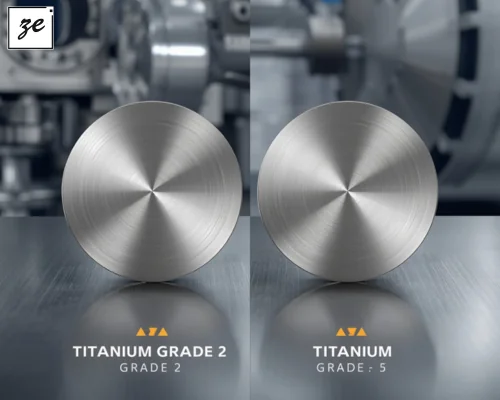
Titanium Grade 2 vs Grade 5: Properties, Applications and Cost Considerations
Titanium sits in a special place among engineering metals. It is light, very strong for its weight and almost immune to seawater corrosion. That combination makes it valuable in aerospace, marine, chemical and medical industries.
Titanium Grade 2 vs Grade 5 is the comparison buyers meet most often. Grade 2 is commercially pure titanium, prized for corrosion resistance and formability. Grade 5 is an alloy built for strength. Choosing between them depends on what the part must do.
The Challenge in Choosing a Titanium Grade
Titanium costs more than stainless steel and most nickel alloys, so using the wrong grade is expensive. Over-specifying adds cost; under-specifying risks mechanical failure.
Key questions to settle first:
- Is corrosion resistance or strength the main requirement?
- Will the part be formed, bent or welded heavily?
- What are the operating temperature and loads?
- Which product forms and standards apply?
Composition and Microstructure
Titanium Grade 2 properties come from its near-pure composition (UNS R50400), with small controlled amounts of oxygen and iron. It has an alpha microstructure that is ductile and easy to form.
Titanium Grade 5 (Ti-6Al-4V), UNS R56400, contains about 6% aluminium and 4% vanadium. These additions create an alpha-beta structure that can be heat treated to high strength.
In short:
- Grade 2 focuses on corrosion resistance and formability
- Grade 5 focuses on strength and fatigue performance
- Both have low density, about 4.4–4.5 g/cm³
- Both resist seawater and many chemicals
Mechanical Properties Compared
Grade 2 typically offers about 345 MPa minimum tensile and 275 MPa minimum yield strength. Grade 5 reaches about 895 MPa tensile and 828 MPa yield in the annealed condition.
That gives Grade 5 roughly three times the yield strength of Grade 2, at almost the same weight. Ti-6Al-4V strength is why it dominates aerospace fasteners, turbine parts and high-load components.
Corrosion Resistance
Both grades form a stable oxide film that resists seawater, chlorides and many oxidising acids. Grade 2 generally performs slightly better in aggressive chemical service and is the standard choice for heat exchangers and chemical piping.
Grade 5 still offers excellent seawater resistance, which is why it is used for marine hardware and offshore components that also need strength. For broader context on corrosion-resistant materials, see our guide to choosing materials for seawater applications.
Applications by Grade
Titanium Grade 2 applications include heat exchanger and condenser tubes, desalination plants, chemical process piping, tanks and architectural parts.
Grade 5 is used for aerospace structures, fasteners, compressor blades, medical implants, high-performance automotive parts and offshore riser components.
Cost Considerations
Titanium Grade 2 vs Grade 5 costs differ beyond raw material price:
- Grade 5 usually costs more per kilogram
- Grade 5 is harder to machine, raising processing costs
- Grade 2 is easier to form and weld, reducing fabrication cost
- Grade 5's strength can reduce section size and weight
Standards and Product Forms
Titanium Grade 2 and Grade 5 are commonly ordered to ASTM B348 for bars, B265 for sheet and plate, and B338 or B861 for tubes and pipe. Aerospace Grade 5 often follows AMS specifications instead. The International Titanium Association publishes useful background on grades and applications. For seawater systems where titanium is not essential, super duplex steel can offer a lower-cost alternative with strong chloride resistance.
Long-Term Cost Savings
Both grades offer very long service life in corrosive environments. Fewer replacements, minimal corrosion allowance and low maintenance often justify titanium's higher upfront price, especially in seawater systems.
Sustainability and Industry Trends
Titanium components can last for the full life of a plant or vessel, reducing waste and replacement work. Lightweight Grade 5 parts also cut fuel use in aerospace and transport. Titanium scrap is widely recycled, supporting more circular supply chains.
Bulk Stock and Global Supply
Alongside its Nickel Alloys and Exotic Alloys range, Zeon Exports supports buyers who need titanium within wider project packages. Our team in Mumbai assists with specification review, documentation, cutting and machining services and worldwide delivery.
Get a quotation now & build the relationship.
Share your titanium grade, size and quantity requirements. Our team will review your enquiry and get back to you with a quotation.
Contact Details
- Phone: +91 98205 33105
- Email: sales@zeonexports.com
- Address: A-7/9, Saboo Building, Ardeshir Dady Cross Lane, Cawasji Patel Tank Road, Mumbai – 400004
Related Blog Posts
Material Selection for Seawater and Desalination Plants: A Technical Buyer's Guide
Inconel 600 vs Inconel 625: Comparative Analysis of Composition, Mechanical Properties and Applications
Hastelloy C276 vs C22: Material Selection for Chemical Processing Environments
Frequently Asked Questions
Q1. What is the difference between Titanium Grade 2 and Grade 5?
Grade 2 is commercially pure titanium focused on corrosion resistance, while Grade 5 is Ti-6Al-4V alloy focused on strength.
Q2. How strong is Ti-6Al-4V compared with Grade 2?
Ti-6Al-4V strength is roughly three times Grade 2's yield strength at almost the same density.
Q3. What are common Titanium Grade 2 applications?
Heat exchangers, condensers, desalination equipment, chemical piping and tanks.
Q4. Which grade is easier to fabricate?
Grade 2 is easier to form and weld; Grade 5 is harder to machine.
Q5. Is titanium suitable for seawater?
Yes. Both grades show excellent resistance to seawater and chloride environments.