


Inconel 600 vs Inconel 625: Comparative Analysis of Composition, Mechanical Properties and Applications
Nickel alloys are chosen when stainless steel runs out of headroom — at high temperatures, in aggressive chemicals or in seawater. Within this family, two names come up again and again in specifications, enquiries and plant upgrades.
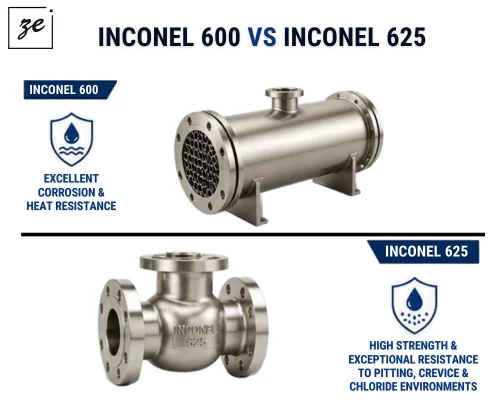
Inconel 600 vs Inconel 625 is a comparison between a proven heat-resisting workhorse and a stronger, more corrosion-resistant successor. Both are nickel-chromium alloys, but small differences in chemistry lead to very different performance in the field.
The Challenge in Selecting a Nickel Alloy
Buyers often treat all "Inconel" grades as interchangeable. In practice, the wrong choice can mean cracking, pitting or oxidation long before the planned service life.
Typical questions a project team must settle first:
- Is the main risk heat, chemicals, seawater or a mix of all three?
- What strength is required at operating temperature?
- Will the part be welded, formed or machined heavily?
- What product forms and sizes are needed, and how quickly?
Why Composition Separates the Two Grades
Inconel 600 composition (UNS N06600) is simple: at least 72% nickel, 14–17% chromium and 6–10% iron. There is no molybdenum or niobium. This gives excellent resistance to oxidation, carburising and chloride stress corrosion cracking.
Alloy 625 (UNS N06625) is built differently. It carries about 20–23% chromium, 8–10% molybdenum and 3.15–4.15% niobium, with iron kept to 5% or less. The comparison breaks down like this:
- Molybdenum gives 625 far better pitting and crevice resistance
- Niobium stiffens the matrix, raising strength without heat treatment
- 600 relies mainly on nickel and chromium for heat and oxidation resistance
- 625 handles both high temperature and wet corrosive service
This is why Inconel 625 corrosion resistance is preferred in seawater and acidic environments.
Mechanical Properties Compared
Inconel 600 vs 625 mechanical properties show a clear gap. Annealed Alloy 600 typically offers around 240 MPa yield and 550 MPa tensile strength. Annealed Alloy 625 usually reaches about 415 MPa yield and over 820 MPa tensile.
That extra strength allows thinner walls in pressure equipment and lighter components in aerospace and offshore designs. Both alloys keep good ductility and toughness down to cryogenic temperatures.
Performance at High Temperature
Inconel 600 high temperature service is where the alloy built its reputation. It resists oxidation up to about 1,100°C and stands up to nitriding and carburising atmospheres. Furnace parts, heat-treatment fixtures and thermocouple sheaths are common uses.
Alloy 625 also performs well at heat, with good creep and fatigue strength. However, long exposure in the roughly 600–800°C range can reduce its ductility, so designers should check the duty cycle carefully.
Applications by Industry
Inconel 625 applications include seawater piping, offshore risers, flue-gas scrubbers, chemical process equipment, aerospace bellows and weld overlay on carbon steel. It is also widely used as a filler metal for joining dissimilar alloys.
Inconel 600 is common in heat-treating furnaces, chemical and food processing, electronic parts and older nuclear steam generator tubing. For a broader look at choosing between nickel grades, read our article on whether your project needs Alloy 400 or Alloy 625 and why engineers prefer Alloy 625.
Standards and Product Forms
Alloy 600 is commonly ordered to ASTM B166 for bars, B168 for plate and B167 for pipe. Alloy 625 follows ASTM B446, B443 and B444 for the same forms. The Nickel Institute publishes free technical guides on both alloys. Stating the UNS number and heat-treatment condition on the order avoids confusion between annealed and solution-annealed material.
Long-Term Cost Savings
Alloy 625 costs more per kilogram, but the comparison of Inconel 600 vs Inconel 625 should include total life cost:
- Higher strength can reduce section thickness and weight
- Better pitting resistance lowers failure risk in wet service
- Fewer shutdowns and replacements over the plant's life
- Alloy 600 remains the economical choice for dry, high-heat duty
Sustainability and Industry Trends
Nickel alloys last for decades when correctly chosen, which cuts scrap and replacement work. Both grades are also highly recyclable. As plants push for higher efficiency at higher temperatures, demand for reliable nickel alloys like 625 continues to grow in energy and process industries.
Bulk Stock and Global Supply
Zeon Exports stocks a wide range of Nickel Alloys, including Alloy 625 in round bars, sheets, plates, pipes, tubes, fittings and flanges. We supply customers in oil and gas, chemical, marine, aerospace and power sectors worldwide, with full documentation and value-added services such as cutting and machining.
Get a quotation now & build the relationship.
Tell us your temperature, media and size requirements. Our team will help you compare grades and respond quickly with a quotation.
Contact Details
- Phone: +91 98205 33105
- Email: sales@zeonexports.com
- Address: A-7/9, Saboo Building, Ardeshir Dady Cross Lane, Cawasji Patel Tank Road, Mumbai – 400004
Related Blog Posts
Hastelloy C276 vs C22: Material Selection for Chemical Processing Environments
Monel 400 vs Monel K500: Performance Comparison for Marine and Offshore Applications
Seamless vs Welded Nickel Alloy Pipes: Cost, Mechanical Performance and Application Criteria
Frequently Asked Questions
Q1. What is the key difference between Inconel 600 and Inconel 625?
Alloy 625 adds molybdenum and niobium, giving higher strength and much better pitting and crevice corrosion resistance.
Q2. Which grade is better for seawater service?
Inconel 625 corrosion resistance makes it the usual choice for seawater, while 600 is not generally preferred for chloride pitting service.
Q3. Where does Inconel 600 high temperature performance matter most?
In furnace parts, heat-treatment fixtures and atmospheres that cause oxidation, carburising or nitriding.
Q4. How do Inconel 600 vs 625 mechanical properties compare?
Annealed 625 typically has well over 1.5 times the yield strength of annealed 600.
Q5. Can Zeon Exports supply Alloy 625 in different forms?
Yes. Zeon Exports supplies Alloy 625 bars, plates, pipes, fittings and flanges with mill test certificates.