


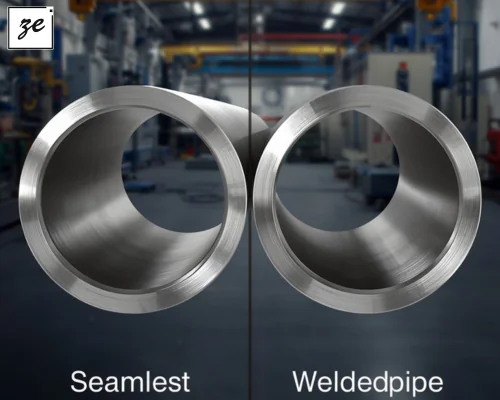
Seamless vs Welded Nickel Alloy Pipes: Cost, Mechanical Performance and Application Criteria
Nickel alloy piping is expensive, so every specification decision carries real cost. One of the first choices on any line list is whether the pipe should be seamless or welded.
Seamless vs welded nickel alloy pipes is not a question of good versus bad. Both are made to recognised ASTM standards and both perform well when correctly specified. The right answer depends on pressure, size, service and budget.
The Challenge for Buyers and Engineers
Specifying seamless everywhere can inflate project costs and stretch delivery times. Specifying welded everywhere can create problems in high-pressure or cyclic service.
Before deciding, teams should define:
- Design pressure, temperature and cyclic loading
- Pipe size and wall thickness range
- Corrosive media and weld-zone sensitivity
- Applicable piping code (such as ASME B31.3)
- Required lead time and budget
How Each Type Is Made
Seamless nickel alloy pipe is produced by piercing or extruding a solid billet, then cold working to size. There is no longitudinal weld seam.
Welded nickel alloy pipe is formed from plate or strip and joined with a longitudinal weld, often followed by solution annealing and non-destructive testing.
Common standards include:
- Alloy 625: ASTM B444 seamless, ASTM B705 welded
- Alloy C276: ASTM B622 seamless, ASTM B619 welded pipe
- Alloy 400: ASTM B165 seamless, ASTM B725 welded
Mechanical Performance Compared
Seamless pipe has uniform properties around its circumference with no seam to inspect. This makes it the preferred choice for high pressure, fatigue and critical service.
Welded pipe offers excellent wall-thickness consistency and concentricity, since it starts from rolled plate or strip. Under ASME B31.3, a longitudinal weld usually has a joint quality factor below 1.0 unless it receives full radiography, which can affect required wall thickness.
Cost and Availability
Nickel alloy pipe cost differs sharply between the two types:
- Welded pipe is usually cheaper, especially in larger diameters
- Seamless nickel alloy pipe is limited in very large sizes
- Welded pipe is often faster to produce for big-bore lines
- Seamless pipe carries a premium for small, thick-walled sizes
For large-bore, low-to-moderate pressure lines, welded pipe can save a significant share of material cost.
Application Criteria
Use seamless pipe for:
- High-pressure and high-temperature process lines
- Cyclic or fatigue-loaded systems
- Sour service and critical hydrocarbon lines
- Small bores with heavy walls
Use welded nickel alloy pipe for:
- Large-diameter lines and ducting
- Low to moderate pressure chemical and scrubber service
- Seawater and cooling water systems where code permits
- Projects where cost and lead time are key
Our article on duplex stainless steel vs nickel alloys helps where the material choice itself is still open.
Testing and Inspection Requirements
Welded nickel alloy pipe is usually checked with radiography or ultrasonic testing on the weld seam, plus hydrostatic or eddy current testing. Seamless pipe is tested along its full length with hydrostatic or non-destructive methods as the standard requires. Buyers should state any extra tests clearly, such as intergranular corrosion tests or 100% radiography. Piping design rules come from ASME B31.3, which defines the joint quality factors used in wall-thickness calculations.
Long-Term Cost Savings
Choosing correctly between seamless vs welded nickel alloy pipes saves money at every stage:
- Avoids paying a seamless premium where welded is acceptable
- Reduces failure risk in critical high-pressure lines
- Shortens lead times on large-bore welded pipe
- Supports accurate wall-thickness design under code rules
Sustainability and Industry Trends
Welded pipe makes efficient use of plate and strip, while seamless pipe offers long life in critical service. Using each where it fits reduces wasted material and over-design. Modern weld quality and NDT have also widened the range of service where welded pipe is accepted.
Bulk Stock and Global Supply
Zeon Exports supplies nickel alloy pipes and tubes in seamless and welded forms across Alloy 400, 625, C276 and other Nickel Alloys. We support projects worldwide with mill test certificates, NDT and inspection, plus matching fittings and flanges.
Get a quotation now & build the relationship.
Send us your pipe sizes, schedules and service conditions. Our team will advise on seamless or welded supply and provide a quotation.
Contact Details
- Phone: +91 98205 33105
- Email: sales@zeonexports.com
- Address: A-7/9, Saboo Building, Ardeshir Dady Cross Lane, Cawasji Patel Tank Road, Mumbai – 400004
Related Blog Posts
Inconel 600 vs Inconel 625: Comparative Analysis of Composition, Mechanical Properties and Applications
Hastelloy C276 vs C22: Material Selection for Chemical Processing Environments
Interpreting Mill Test Certificates: EN 10204 3.1 vs 3.2 Explained for Buyers
Frequently Asked Questions
Q1. What is the main difference between seamless and welded nickel alloy pipes?
Seamless pipe has no longitudinal weld, while welded pipe is formed from plate or strip and joined along its length.
Q2. Is seamless nickel alloy pipe always stronger?
It offers uniform properties with no seam, making it preferred for high pressure and fatigue service.
Q3. Why is welded nickel alloy pipe cheaper?
It is made from flat product, which is more economical, especially in larger diameters.
Q4. What affects nickel alloy pipe cost most?
Alloy grade, seamless or welded construction, diameter, wall thickness and testing requirements.
Q5. Does Zeon Exports supply both seamless and welded pipes?
Yes. Zeon Exports supplies both types in multiple nickel alloy grades with full documentation.