


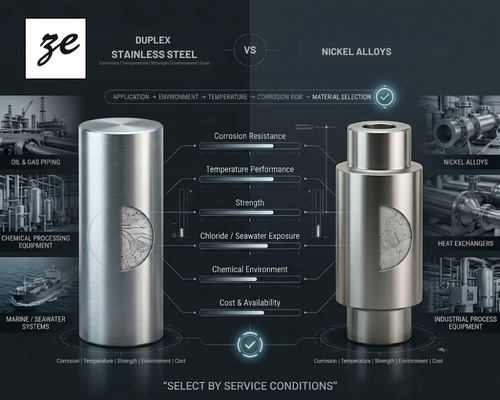
Duplex Stainless Steel vs Nickel Alloys: How to Select the Right Material
Choosing the right material for an industrial project is not simply about selecting the strongest metal available. The material must match the operating environment, temperature, pressure, corrosion risk, fabrication requirements, service life, and overall project budget. This is where the comparison of Duplex Stainless Steel vs Nickel Alloys becomes important.
Both materials are widely used in demanding industries such as oil and gas, chemical processing, marine engineering, power generation, desalination, and petrochemicals. However, they perform differently under specific conditions. Understanding these differences can help engineers, procurement teams, and project managers make a practical material choice.
Understanding Duplex Stainless Steel
Duplex stainless steel combines austenitic and ferritic phases in its microstructure. This combination gives it a useful balance of strength, corrosion resistance, and fabrication properties. Grades such as Alloy 2205 are known for good resistance to pitting, crevice corrosion, stress corrosion cracking, and general corrosion.
One of the biggest advantages of duplex stainless steel is its high mechanical strength. It can often allow designers to use thinner sections while still meeting strength requirements. Its relatively lower nickel content compared with many nickel-based alloys can also make it an attractive option from a cost perspective.
For example, a piping system exposed to seawater or chloride-containing fluids may benefit from duplex or super duplex stainless steel. Alloy 2205 is commonly considered for demanding process applications, while super duplex grades such as Alloy 2507/F53 and F55 provide higher corrosion resistance for more aggressive environments.
When purchasing material, working with experienced duplex stainless steel suppliers is important because grade, dimensions, certification, heat treatment, and traceability can directly affect performance.
Understanding Nickel Alloys
Nickel alloys are designed for applications where ordinary stainless steels may not provide sufficient resistance. Their performance can be particularly valuable in severe chemical environments, high temperatures, and applications involving highly corrosive media.
Grades such as Alloy 625, Alloy 718, Alloy 825, Alloy C276, Alloy 400, and K500 are used for different combinations of corrosion resistance, mechanical strength, and temperature performance. Zeon Exports supplies nickel alloys in several product forms for demanding industrial applications.
This makes nickel alloy suppliers especially important when the project involves unusual chemical exposure or elevated temperatures. For instance, some high temperature nickel alloys are selected for components that must maintain mechanical performance when exposed to significant heat.
Nickel alloys can also be more expensive than duplex stainless steel. Therefore, selecting a nickel alloy simply because it is considered a premium material may unnecessarily increase project costs if duplex stainless steel can safely meet the operating requirements.
Duplex Stainless Steel vs Nickel Alloys: Key Differences
The practical decision between these two material families starts with the service environment.
Corrosion resistance: Duplex stainless steel offers excellent resistance to many chloride-containing environments, particularly grades designed for demanding service. Super duplex can provide even greater resistance. Nickel alloys, however, can be preferable when the environment contains highly aggressive chemicals or combinations of corrosive conditions that exceed the capabilities of duplex grades.
Temperature: Duplex stainless steel is suitable for many industrial applications, but temperature limits and phase stability must be considered carefully. When an application involves prolonged exposure to elevated temperatures, certain nickel alloys may provide a better solution. This is one reason high temperature nickel alloys are widely considered in specialized thermal applications.
Strength: Duplex stainless steel offers a strong combination of tensile and yield strength. This can help reduce material thickness in certain designs. Nickel alloys can also provide excellent strength, especially in grades developed for high-temperature or demanding mechanical service.
Cost: Duplex stainless steel will often be more economical than nickel-based materials, although the actual project cost depends on grade, availability, thickness, manufacturing, fabrication, and lifecycle requirements. A lower purchase price is useful only when the material provides sufficient service life.
How to Select the Right Material
Start with the operating environment rather than the material price. Ask what chemicals will contact the component, whether chlorides are present, the expected temperature range, pressure conditions, and whether the equipment will experience seawater, sour service, cyclic loading, or abrasive conditions.
Next, consider the component itself. A process line may require Duplex Steel Pipes & Tubes, while fabricated equipment may require Duplex Steel Sheets & Plates. Machined shafts and similar components may be manufactured from Duplex Steel Round Bars.
Connections also deserve attention. A high-quality pipe system can still become a weak point if the connected components are not compatible with the service conditions. For this reason, engineers may specify Duplex Steel Fittings, Duplex Steel Flanges, and suitable fasteners for the same operating environment.
The final decision should also consider welding, machining, inspection, certification, availability, and expected maintenance. Zeon Exports supplies duplex, super duplex, nickel alloys, and other exotic grades in multiple forms, helping customers evaluate material choices according to project requirements.
Where Each Material Makes Sense
Duplex stainless steel is often a practical choice when the project needs high strength, good corrosion resistance, and reasonable material economics. It is commonly considered for oil and gas systems, desalination plants, marine applications, chemical processing, heat exchangers, and water-handling equipment.
Nickel alloys become more attractive when the environment is exceptionally corrosive, when specific chemical resistance is required, or when elevated-temperature mechanical performance is a major concern.
The goal is therefore not to ask which material is universally better. The better question is: Which material provides the required performance for the actual service conditions?
Why Choose Zeon Exports?
Zeon Exports is an established supplier of Duplex Steel, Super Duplex Steel, Nickel Alloys, and other exotic materials. Its product range includes round bars, sheets and plates, pipes and tubes, structural profiles, fasteners, fittings, flanges, and industrial valves.
The company maintains extensive inventory across multiple grades and provides material documentation, quality checks, cutting and machining capabilities, and global supply support.
Whether you are comparing Alloy 2205 with Alloy 625, selecting material for a seawater application, or evaluating a high-temperature component, discussing the operating conditions with an experienced supplier can help prevent costly material-selection mistakes.
Frequently Asked Questions
Q1. Is duplex stainless steel better than nickel alloys?
Not in every application. Duplex stainless steel can offer an excellent combination of strength, corrosion resistance, and cost, while nickel alloys may be better for severe chemical or high-temperature environments.
Q2. When should I choose super duplex steel?
Super duplex is worth considering when higher resistance to pitting, crevice corrosion, and stress corrosion cracking is required, particularly in chloride-rich and offshore environments.
Q3. Are nickel alloys suitable for high-temperature applications?
Certain nickel grades are specifically developed for demanding temperature conditions. The correct grade should be selected based on the actual operating temperature, mechanical loads, and surrounding environment.
Q4. What information should I provide to a material supplier?
Provide the application, operating temperature, pressure, fluid or chemicals involved, required dimensions, applicable standards, quantity, and certification requirements. This allows the supplier to recommend a suitable grade and product form.
Q5. Can Zeon Exports supply both duplex stainless steel and nickel alloys?
Yes. Zeon Exports supplies Duplex Steel, Super Duplex Steel, Nickel Alloys, and other exotic alloy grades in forms including bars, plates, pipes, tubes, fittings, flanges, fasteners, and valves.
Contact Zeon Exports
- Address: A-7/9, Saboo Building, Ardeshir Dady Cross Lane, Cawasji Patel Tank Road, Mumbai – 400004
- Phone: +91 98205 33105
- Email: sales@zeonexports.com
- Website: www.zeonexports.com
For material selection, availability, specifications, and export requirements, contact Zeon Exports with your project details.