


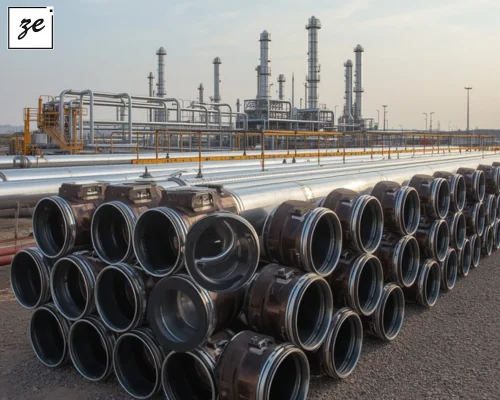
Super Duplex Steel Pipes for Middle East Oil & Gas Projects: Specifications and Procurement Guide
The Middle East remains one of the world's busiest regions for oil and gas investment. New offshore fields, gas processing plants and water injection systems all need piping that can survive high pressure, hot climates and chloride-rich fluids.
Super duplex steel pipes for Middle East oil & gas projects have become a standard choice in these conditions. This guide explains the key specifications and what buyers should check when sourcing them.
The Challenge in Middle East Oil & Gas Service
Regional projects combine several demanding factors at once. High ambient temperatures, seawater-based systems and produced water with high salinity are all common.
Typical pressures on piping include:
- Seawater injection and cooling-water systems
- Produced water with high chloride content
- Sour service with hydrogen sulphide (H₂S)
- High design pressures in process and injection lines
- Long project schedules with strict vendor approval
Why Super Duplex Is Selected
Super Duplex 2507 / F53 (UNS S32750) and F55 (UNS S32760) offer PREN values of 40 or more and about 550 MPa minimum yield strength. Compared with carbon steel or 316L, they provide:
- Strong resistance to pitting and crevice corrosion
- High resistance to chloride stress corrosion cracking
- Thinner walls and lower weight for the same pressure
- No need for internal coatings or large corrosion allowances
This is why super duplex pipes for oil and gas are widely used in seawater injection and firewater systems.
Key Pipe Specifications
The most common ASTM A790 super duplex pipe standard covers seamless and welded duplex pipe. Related standards include ASTM A789 for tubes and ASTM A928 for larger welded pipe. Our article on ASTM A790, A182 and A240 explains how these fit together.
Buyers should define:
- Grade (S32750 or S32760) and minimum PREN on heat analysis
- Seamless or welded, size and schedule
- Heat treatment and microstructure checks (ferrite content, no intermetallic phases)
- Corrosion testing such as ASTM G48 where specified
- Hardness limits for sour service under NACE MR0175 / ISO 15156
Procurement and Vendor Approval
Middle East pipe procurement often follows end-user specifications from major national oil companies and EPC contractors. These may require approved manufacturers, pre-production meetings and witnessed testing.
A capable supplier should provide EN 10204 3.1 or 3.2 certificates, positive material identification, dimensional reports and third-party inspection by agencies such as TÜV, BV, DNV or Lloyd's. Read more in our guide for Middle East duplex projects.
Fittings, Flanges and Complete Packages
Pipes are only part of the system. Matching super duplex fittings and flanges from the same grade keeps corrosion performance consistent. Sourcing a complete piping package from one supplier also simplifies documentation and logistics. Our article on super duplex for high-pressure oil and gas pipelines covers this in more detail.
Lead Times and Logistics
Mumbai's ports offer short sea transit to the Gulf, often around one to two weeks to Jebel Ali, Dammam or Hamad. Ex-stock super duplex pipe can usually be tested, inspected and shipped within a few weeks, while mill orders take longer. Planning inspection dates early avoids delays at the end of a schedule. Sour-service requirements should follow the NACE MR0175 / ISO 15156 edition named in the project specification, published through AMPP.
Long-Term Cost Savings
Super duplex steel pipes for Middle East oil & gas projects deliver savings over the asset's life:
- Lower weight reduces transport and installation cost
- No internal coating or inhibitor dependence
- Fewer leaks and shutdowns in seawater systems
- Longer design life with less inspection work
Sustainability and Industry Trends
Operators in the region are focusing on longer asset life and lower emissions. Corrosion-resistant piping reduces leaks, flaring from shutdowns and replacement work. Water injection and carbon capture projects are also adding new demand for super duplex systems.
Bulk Stock and Global Supply
Zeon Exports holds large stocks of super duplex pipes and tubes, along with fittings, flanges and plates. From Mumbai, our team supplies EPC contractors in the UAE, Saudi Arabia, Qatar, Oman and Kuwait with short transit times, full documentation and inspection support.
Get a quotation now & build the relationship.
Share your project material requisition or line list. Our team will review specifications and respond with a detailed quotation.
Contact Details
- Phone: +91 98205 33105
- Email: sales@zeonexports.com
- Address: A-7/9, Saboo Building, Ardeshir Dady Cross Lane, Cawasji Patel Tank Road, Mumbai – 400004
Related Blog Posts
Duplex 2205 vs Super Duplex 2507: A Technical Comparison for Grade Selection
ASTM A182 F51, F53 and F55 Flanges: A Grade-by-Grade Technical Comparison
Importing Duplex and Nickel Alloy Products from India: Procedure, Documentation and Lead Times
Frequently Asked Questions
Q1. Which standard covers ASTM A790 super duplex pipe?
ASTM A790 covers seamless and welded ferritic-austenitic pipe, including S32750 and S32760 grades.
Q2. Why are super duplex pipes for oil and gas preferred in seawater injection?
They resist chloride pitting and stress corrosion cracking while allowing thinner, lighter walls.
Q3. Can super duplex be used in sour service?
Yes, within the hardness and environmental limits set by NACE MR0175 / ISO 15156.
Q4. What documents are needed for Middle East pipe procurement?
Usually EN 10204 3.1 or 3.2 certificates, test reports, PMI and third-party inspection records.
Q5. Does Zeon Exports supply to Middle East projects?
Yes. Zeon Exports supplies super duplex pipes, fittings and flanges to EPC contractors across the region.