


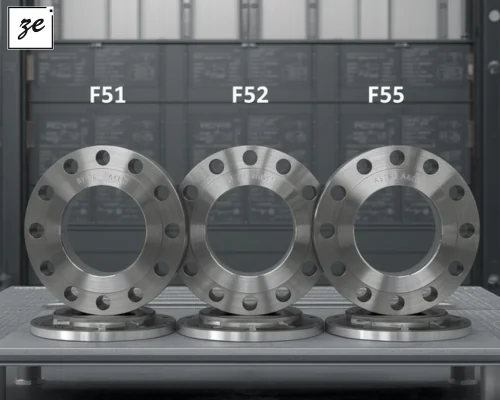
ASTM A182 F51, F53 and F55 Flanges: A Grade-by-Grade Technical Comparison
Flanges are small parts with a big job. They hold pressure, carry bolt loads and sit in the exact places where crevices and leaks tend to start. In duplex piping systems, the flange grade must match the corrosion demands of the line.
ASTM A182 F51, F53 and F55 flanges are the three duplex and super duplex forged grades buyers meet most often. They look alike on a drawing, but their chemistry and performance differ in ways that matter.
The Challenge in Choosing a Flange Grade
A flange must perform as well as the pipe it joins. If the flange grade is weaker in corrosion terms, it becomes the system's weak point.
Common selection questions include:
- What PREN does the piping specification require?
- Is the service seawater, produced water or chemical?
- What pressure class and flange type are needed?
- Does the project prefer one specific super duplex grade?
Grade Designations Explained
ASTM A182 covers forged flanges, fittings and valve parts. The three duplex grades are:
- F51 — UNS S31803, the standard 22Cr Duplex 2205 grade (F60 covers the tighter S32205 chemistry)
- F53 — UNS S32750, Super Duplex 2507
- F55 — UNS S32760, super duplex with copper and tungsten
Understanding these designations is the first step in A182 duplex flange grade selection.
Chemical Composition Compared
F51 duplex flange material contains about 21–23% chromium, 2.5–3.5% molybdenum and 0.08–0.20% nitrogen, giving a PREN of around 33–35.
F53 super duplex flange material raises this to 24–26% chromium, 3–5% molybdenum and 0.24–0.32% nitrogen, with PREN 41 or more.
F55 has similar chromium and molybdenum, plus 0.5–1.0% each of copper and tungsten. F55 tungsten super duplex PREN, calculated with tungsten, is 40 or more. Copper can help in some sulphuric acid environments.
Mechanical Properties
Typical A182 minimum properties are:
- F51: about 620 MPa tensile, 450 MPa yield
- F53: about 800 MPa tensile, 550 MPa yield
- F55: about 750 MPa tensile, 550 MPa yield
All three have minimum elongation around 25%. The higher strength of F53 and F55 suits higher-pressure systems.
Choosing Between F53 and F55
F53 and F55 offer similar seawater performance. In practice, the choice often depends on the project specification, end-user preference and availability. Some operators standardise on F55; others accept either if the PREN and test requirements are met.
Our article on super duplex F53 and F55 forged fittings explains these differences further. Both grades require careful heat treatment to avoid sigma phase, as covered in how heat treatment affects duplex and super duplex.
Applications by Grade
- F51: chemical plants, wastewater, brackish water, general process piping
- F53: seawater, desalination, offshore topsides, firewater systems
- F55: subsea, seawater injection, offshore and specifications that call for UNS S32760
Flange types include weld neck, slip-on, blind, socket weld, threaded and lap joint, made to ASME B16.5 or B16.47.
Testing and Documentation
Project specifications for super duplex flanges often add tests beyond the basic A182 requirements. Common extras include ferrite content checks, Charpy impact tests at −46°C, ASTM G48 corrosion tests and microstructure examination for intermetallic phases. Each flange should carry a heat number that traces to its mill test certificate. Full ASTM A182 requirements are available from ASTM International. Clear test requirements in the purchase order prevent rejection during third-party inspection.
Long-Term Cost Savings
Correctly matched ASTM A182 F51, F53 and F55 flanges reduce costs across the piping system:
- Avoid flange-face pitting and leaks at gaskets
- Reduce shutdowns and replacement work
- Allow lighter flanges at high pressure classes
- Use F51 where adequate to control budget
Sustainability and Industry Trends
Long-lasting flanges mean fewer replacements, less scrap and fewer leak-related emissions. Projects increasingly ask for full traceability and verified PREN on each flange, supporting safer and more efficient plants.
Bulk Stock and Global Supply
Zeon Exports supplies duplex and super duplex flanges in F51, F53 and F55, along with matching pipes and fittings. We support EPC and OEM buyers worldwide with mill test certificates, PMI, machining and third-party inspection.
Get a quotation now & build the relationship.
Send us your flange list with sizes, classes and grades. We will respond quickly with availability and a competitive quotation.
Contact Details
- Phone: +91 98205 33105
- Email: sales@zeonexports.com
- Address: A-7/9, Saboo Building, Ardeshir Dady Cross Lane, Cawasji Patel Tank Road, Mumbai – 400004
Related Blog Posts
Duplex 2205 vs Super Duplex 2507: A Technical Comparison for Grade Selection
Pitting Resistance Equivalent Number (PREN): Its Role in Duplex Steel Selection
Super Duplex Steel Pipes for Middle East Oil & Gas Projects: Specifications and Procurement Guide
Frequently Asked Questions
Q1. What UNS grades match ASTM A182 F51, F53 and F55 flanges?
F51 is UNS S31803, F53 is UNS S32750 and F55 is UNS S32760.
Q2. Is an F51 duplex flange suitable for seawater?
F51 suits many brackish and process applications, but F53 or F55 is usually preferred for seawater.
Q3. What makes F55 tungsten super duplex different?
F55 contains copper and tungsten, and its PREN is calculated including tungsten.
Q4. Are F53 and F55 interchangeable?
They have similar performance, but the project specification decides which A182 duplex flange grade is acceptable.
Q5. Does Zeon Exports supply all three grades?
Yes. Zeon Exports supplies F51, F53 and F55 flanges with certification and inspection support.