


How Heat Treatment Affects Duplex and Super Duplex Stainless Steel
When a manufacturer selects Duplex or Super Duplex stainless steel for a demanding industrial application, the material grade is only part of the story. The way the steel is heated, treated, cooled, formed, and finished can have a major effect on its final performance. This is especially important because Duplex stainless steel depends on a balanced combination of austenite and ferrite phases. Zeon Exports supplies Duplex and Super Duplex Steel products for demanding industries where strength, corrosion resistance, and long service life are essential.
Why Heat Treatment Matters in Duplex Stainless Steel
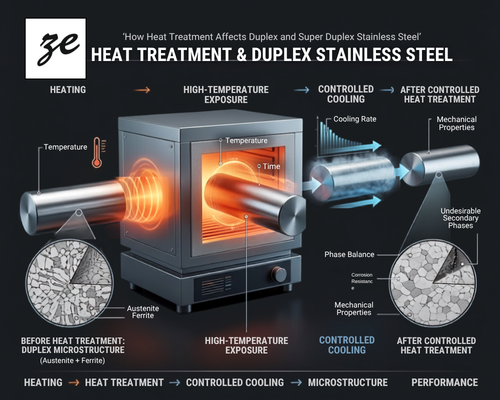
Duplex stainless steel is different from conventional austenitic stainless steel because its microstructure contains both ferrite and austenite. The correct balance between these two phases gives grades such as Duplex 2205 their combination of high strength and corrosion resistance.
During manufacturing, fabrication, welding, or forming, heat can change this balance. If the material remains at unsuitable temperatures for too long, unwanted phases can form. These changes can reduce toughness and corrosion resistance.
This is why Duplex stainless steel heat treatment must be carefully controlled. The objective is not simply to make the steel harder or softer. It is to restore the desired metallurgical structure while maintaining the properties required for service.
What Is Duplex Stainless Steel Solution Annealing?
Duplex stainless steel solution annealing is one of the most important heat-treatment processes used for Duplex grades. The material is heated into an appropriate solution-annealing temperature range so that undesirable precipitates can dissolve. It is then cooled rapidly, commonly by water quenching, to retain the required two-phase structure.
The exact temperature, holding time, and cooling procedure depend on the grade, product form, thickness, applicable specification, and manufacturing process. For this reason, heat treatment should always follow the relevant material standard and approved procedure rather than relying on a general temperature alone.
For example, a manufacturer producing Duplex Steel Sheets & Plates must consider thickness and previous thermal processing when determining the appropriate treatment.
Heat Treatment of Super Duplex Stainless Steel
Super duplex stainless steel heat treatment follows the same basic principle but requires particularly careful control because these alloys contain higher levels of alloying elements and are intended for extremely demanding environments.
Grades such as Super Duplex 2507 / F53 and F55 are valued for their high strength and excellent resistance to pitting, crevice corrosion, and stress corrosion cracking.
Improper heating or slow cooling can encourage the formation of undesirable intermetallic phases, including sigma phase. These phases can significantly reduce toughness and corrosion resistance. Therefore, controlling the time spent within critical temperature ranges is essential.
This becomes particularly important when manufacturing Super Duplex Steel Pipes & Tubes, fittings, flanges, and other components intended for offshore, chemical processing, desalination, and oil and gas applications.
The Main Duplex Stainless Steel Heat Treatment Effects
The effects of heat treatment can be seen in several important areas.
1. Microstructure: Correct treatment helps maintain the desired ferrite-austenite balance. An incorrect balance can affect overall material performance.
2. Corrosion resistance: Proper solution treatment supports the corrosion resistance expected from Duplex and Super Duplex grades. Poor thermal control can promote harmful phases and reduce resistance to localized corrosion.
3. Mechanical properties: Heat treatment can help restore appropriate strength, ductility, and toughness after manufacturing operations.
4. Toughness: Rapid and controlled cooling after solution treatment helps prevent unwanted precipitation that could make the material less tough.
5. Fabrication performance: Components that have undergone suitable heat treatment are better prepared for subsequent machining, forming, welding, or service.
For example, Duplex Steel Round Bars used for machined shafts or industrial components need consistent metallurgical properties throughout the material.
Heat Treatment After Welding and Fabrication
Welding introduces significant localized heat into Duplex and Super Duplex stainless steel. If welding parameters are not controlled properly, the heat-affected zone can develop an unsuitable phase balance or unwanted precipitates.
This does not mean every welded component automatically requires post-weld heat treatment. The correct approach depends on the grade, welding procedure, component design, applicable code, and service requirements. In many cases, controlling welding heat input and cooling conditions is more important than applying an unnecessary additional treatment.
For critical assemblies such as Duplex Steel Flanges, Fittings, and Industrial Valves, buyers should confirm the required material condition and inspection documentation before production.
Why Controlled Cooling Is Just as Important
Heating is only half of the process. Cooling rate can be equally important. After solution treatment, rapid cooling is generally used to prevent undesirable phases from forming as the material passes through critical temperature ranges.
Imagine a pipe being prepared for an offshore system. The material may have excellent chemical composition on paper, but if its thermal processing creates an unsuitable microstructure, the finished product may not provide the expected corrosion resistance. Proper heat treatment and documentation therefore become part of overall quality assurance.
Choosing the Right Heat Treatment Support
For industrial buyers, it is important to work with a supplier that understands both material specifications and the final application. Zeon Exports supplies Duplex and Super Duplex products in forms including round bars, sheets, plates, pipes, tubes, fittings, flanges, fasteners, valves, and structural profiles.
For applications requiring bolted connections, Duplex and Super Duplex Steel Fasteners can be supplied with attention to material certification and manufacturing requirements. Proper heat treatment is especially important for high-strength fasteners because the final properties must be consistent and suitable for the intended loading conditions.
The same principle applies to Structural Profiles used in demanding industrial structures. The material condition should match the engineering specification rather than being selected solely on price or availability.
Why Choose Zeon Exports?
Zeon Exports is a Mumbai-based supplier of Duplex Steel, Super Duplex Steel, Nickel Alloys, and other high-performance materials. The company maintains extensive stocks and provides products for industries including oil and gas, marine, chemical processing, power generation, and desalination. Its quality approach includes material traceability, testing, technical support, and third-party inspection options.
For projects where heat treatment is a critical part of the specification, buyers can discuss the required grade, product form, applicable standard, heat-treatment condition, testing requirements, and documentation with the Zeon Exports team before placing an order.
Frequently Asked Questions
Q1. Why is heat treatment important for Duplex stainless steel?
Heat treatment helps maintain the required ferrite-austenite balance and supports the desired strength, toughness, and corrosion resistance of the material.
Q2. What is solution annealing in Duplex stainless steel?
Solution annealing involves heating the material to an appropriate temperature range and then cooling it rapidly to restore a suitable metallurgical structure and reduce unwanted precipitation.
Q3. Does Super Duplex stainless steel require special heat-treatment control?
Yes. Super Duplex grades require careful control of heating and cooling because inappropriate thermal exposure can promote undesirable phases and affect corrosion resistance and toughness.
Q4. Can heat treatment improve corrosion resistance?
Proper heat treatment can help preserve the corrosion resistance expected from a Duplex or Super Duplex grade by maintaining the appropriate microstructure and avoiding harmful precipitates.
Q5. Does Zeon Exports supply heat-treated Duplex and Super Duplex products?
Zeon Exports supplies Duplex and Super Duplex products in multiple forms and can discuss required material conditions, testing, certification, and project-specific requirements with buyers.
Contact Zeon Exports
- Address: A-7/9, Saboo Building, Ardeshir Dady Cross Lane, Cawasji Patel Tank Road, Mumbai – 400004
- Phone: +91 98205 33105
- Email: sales@zeonexports.com
- Website: www.zeonexports.com
For Duplex and Super Duplex Steel requirements, contact Zeon Exports to discuss grades, dimensions, heat-treatment requirements, testing, certification, and global supply options.