


What Is PREN in Stainless Steel? Formula, Calculation & Why It Matters
Stainless steel is selected for industrial applications not only because of its strength but also because of its ability to resist corrosion. When equipment operates in seawater, chloride-rich chemicals, offshore environments, or chemical processing plants, ordinary corrosion resistance may not be enough. This is where PREN in stainless steel becomes an important technical measure.
PREN stands for Pitting Resistance Equivalent Number. It is a calculated value used to compare the resistance of stainless steel grades against pitting corrosion, particularly in chloride-containing environments. A higher PREN generally indicates better resistance to pitting, although the actual performance of a material also depends on temperature, chloride concentration, fabrication, heat treatment, surface condition, and the service environment.
What Is PREN in Stainless Steel?
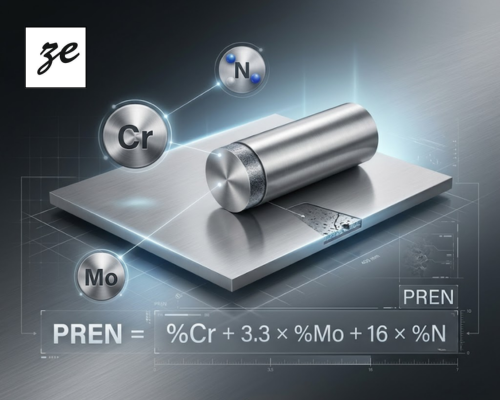
The PREN in stainless steel is a numerical indicator based mainly on the amounts of chromium, molybdenum, and nitrogen present in the alloy. These elements contribute significantly to the formation and stability of the passive layer that protects stainless steel from localized corrosion.
This makes PREN especially useful when engineers are comparing conventional stainless steels with duplex and super duplex grades. For example, Alloy 2205 duplex stainless steel offers significantly higher pitting resistance than many common austenitic grades, while Alloy 2507 super duplex stainless steel provides an even higher level of corrosion resistance.
For demanding applications, Zeon Exports supplies duplex and super duplex products in forms such as Round Bars, Sheets & Plates, and Pipes & Tubes.
PREN Formula for Stainless Steel
The commonly used PREN formula for stainless steel is:
PREN = %Cr + 3.3 × %Mo + 16 × %N
Here:
- Cr = percentage of chromium
- Mo = percentage of molybdenum
- N = percentage of nitrogen
Some modified PREN equations also account for tungsten in specific stainless steel grades. One commonly used version is:
PREN = %Cr + 3.3 × (%Mo + 0.5 × %W) + 16 × %N
The appropriate equation should always be selected according to the material specification or technical standard being used.
How to Calculate PREN Value of Stainless Steel
To calculate PREN value stainless steel, you need the chemical composition of the grade. This information is normally available in the material test certificate or mill test certificate.
For example, consider a simplified composition of a duplex stainless steel containing approximately:
- Chromium = 22%
- Molybdenum = 3%
- Nitrogen = 0.18%
Using the basic formula:
PREN = 22 + (3.3 × 3) + (16 × 0.18)
PREN = 22 + 9.9 + 2.88
PREN = 34.78
So, the calculated PREN is approximately 34.8.
This example demonstrates why nitrogen should not be overlooked. Although it is present in a relatively small percentage, its coefficient in the formula is high, making it an important contributor to the overall PREN value.
PREN Value of Stainless Steel Grades
The PREN value of stainless steel grades varies according to their chemical composition. Common austenitic stainless steels generally have lower PREN values than duplex and super duplex grades.
For example, stainless steel 316/316L typically has a PREN value in the mid-20s, depending on its exact chemistry. Duplex 2205 commonly falls in the low-to-mid 30s, while Super Duplex 2507 is generally above 40.
The actual value can vary because the chemical composition of individual heats may differ within specification limits. Therefore, PREN should be calculated from the actual certified composition when an accurate material comparison is required.
For industrial projects requiring corrosion-resistant components, Zeon Exports offers Alloy 2205 Fittings, Alloy 2205 Fasteners, and Alloy 2205 Flanges.
Why Does PREN Matter?
PREN is useful because pitting corrosion can be difficult to detect in its early stages. A component may look acceptable from the outside while localized pits are developing on its surface. In applications involving seawater, brine, chemical solutions, or other chloride-containing media, these small pits can eventually become serious sources of leakage or structural damage.
A higher PREN grade can therefore be an important consideration when selecting materials for demanding environments.
For example, Super Duplex 2507 is commonly considered for applications such as offshore equipment, desalination systems, chemical processing, oil and gas facilities, and marine systems where high corrosion resistance and mechanical strength are required.
However, PREN should not be treated as the only factor in material selection. Welding procedures, heat treatment, ferrite-austenite balance, surface condition, temperature, and actual operating conditions can all influence corrosion performance.
PREN and Duplex & Super Duplex Stainless Steel
Duplex stainless steels combine ferritic and austenitic phases, providing a useful balance of strength and corrosion resistance. Super duplex grades take this performance further through carefully controlled alloying additions.
For projects where both corrosion resistance and structural performance are important, Super Duplex Structural Profiles can be considered for suitable applications. Zeon Exports also provides a range of industrial products, including Fasteners, Fittings, and other engineered components.
When choosing a grade, buyers should compare the material's certified chemical composition with the required corrosion resistance and applicable project standards rather than relying only on a nominal PREN value.
PREN Is a Guide, Not a Guarantee
It is important to understand that PREN is a comparative index rather than a direct prediction of service life. Two materials with similar PREN values can behave differently under particular operating conditions.
Actual corrosion resistance can be affected by chloride levels, temperature, oxygen availability, deposits, welding, surface contamination, fabrication quality, and exposure time. For critical applications, laboratory corrosion testing and project-specific material standards may be necessary.
This is why material traceability, chemical analysis, inspection, and testing are important when sourcing stainless, duplex, and super duplex products. Zeon Exports provides technical support and testing services, including PMI and other inspection methods according to material and customer requirements.
Frequently Asked Questions
Q1. What does PREN mean in stainless steel?
PREN means Pitting Resistance Equivalent Number. It is a calculated index used to compare the resistance of stainless steel to localized pitting corrosion, especially in chloride-containing environments.
Q2. What is the basic PREN formula for stainless steel?
The commonly used formula is PREN = %Cr + 3.3 × %Mo + 16 × %N. Some formulas include tungsten for suitable grades.
Q3. How do you calculate PREN value stainless steel?
Obtain the chromium, molybdenum, and nitrogen percentages from the certified chemical composition and substitute them into the applicable PREN equation.
Q4. Is a higher PREN always better?
A higher PREN generally indicates greater resistance to pitting, but it does not guarantee better performance in every environment. Temperature, chloride concentration, fabrication, welding, and surface condition also matter.
Q5. Why is PREN important for duplex and super duplex steel?
Duplex and super duplex steels are often used in aggressive environments where pitting resistance is important. PREN provides a convenient way to compare their potential resistance based on alloy chemistry.
Conclusion
Understanding stainless steel PREN calculation makes material selection easier for engineers, procurement teams, and industrial buyers. By considering chromium, molybdenum, and nitrogen content, PREN provides a useful first comparison of pitting resistance between stainless steel grades.
For demanding applications, however, PREN should be considered alongside mechanical properties, service conditions, applicable standards, welding requirements, and certified chemical composition. Zeon Exports specializes in the supply of Duplex Steel and Super Duplex Steel products for industrial applications and offers products across multiple forms and grades.
Contact Zeon Exports
- Address: A-7/9, Saboo Building, Ardeshir Dady Cross Lane, Cawasji Patel Tank Road, Mumbai – 400004
- Phone: +91 98205 33105
- Email: sales@zeonexports.com
- Website: www.zeonexports.com
For duplex and super duplex material requirements, contact Zeon Exports for product availability, technical specifications, and project requirements.