


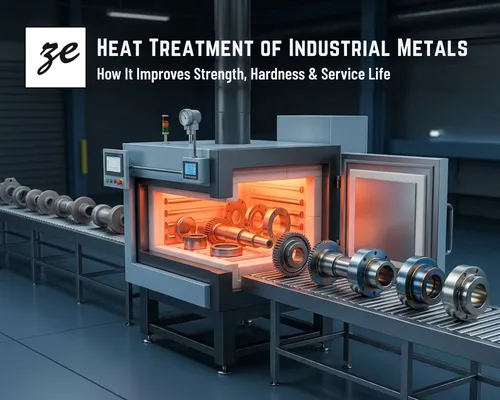
Heat Treatment of Industrial Metals: How It Improves Strength, Hardness and Service Life
Industrial metal components often work under demanding conditions. They may face high pressure, heavy loads, repeated friction, elevated temperatures, corrosive chemicals, or constant mechanical stress. Simply selecting a strong metal is not always enough. The way the material is processed can also have a major effect on its final performance. This is where industrial metal heat treatment becomes important.
Heat treatment is a controlled process in which metal is heated, held at a specific temperature, and cooled in a planned manner. The purpose is to change the internal structure of the material and achieve desired properties such as strength, hardness, toughness, ductility, dimensional stability, and wear resistance. For industries using critical components, properly controlled heat treatment services for industrial metals can help improve reliability and extend service life.
What Is the Metal Heat Treatment Process?
The metal heat treatment process generally involves three basic stages: heating, soaking, and cooling. However, the exact temperature, holding time, and cooling method depend on the type and grade of metal and the required properties.
During heating, the metal reaches a predetermined temperature. It is then held at that temperature long enough for the heat to distribute through the material. Finally, it is cooled at a controlled rate. Cooling may take place in air, water, oil, or another suitable medium depending on the treatment.
Different heat treatment methods are selected for different purposes. Annealing can improve ductility and make a material easier to machine. Normalizing can help refine the structure and improve mechanical properties. Quenching can increase hardness, while tempering can reduce excessive brittleness after hardening. Other specialized treatments are used for specific alloy systems and applications.
How Heat Treatment Improves Metal Strength and Hardness
One of the main reasons manufacturers use heat treatment is to control mechanical performance. A component that experiences heavy loading needs enough strength to resist deformation or failure. Similarly, parts exposed to wear need suitable hardness.
The right heat treatment to improve metal strength and hardness changes the material's internal structure in a controlled way. This can help a component withstand higher loads, repeated operation, impact, and surface wear.
For example, a machined shaft used in an industrial machine may experience continuous rotation and mechanical stress. If its properties are not suitable for the application, premature wear or deformation can occur. Proper treatment can help provide a better balance of hardness and toughness, allowing the component to perform more reliably.
Heat Treatment and Duplex & Super Duplex Steel
Duplex and Super Duplex stainless steels are valued for their combination of strength and corrosion resistance. Grades such as Alloy 2205 and Super Duplex grades such as F53/F55 are used in demanding industries including oil and gas, marine, chemical processing, desalination, power generation, and fabrication. Zeon Exports supplies Duplex and Super Duplex materials in several product forms and supports industrial applications requiring dependable material performance.
For these alloys, heat treatment must be carefully controlled. Incorrect heating or cooling can affect the balance between the austenitic and ferritic phases and may negatively influence corrosion resistance and mechanical properties. Therefore, treatment parameters should be selected according to the specific grade, applicable standard, product form, and service requirements.
When purchasing material for fabrication or machining, buyers should also consider documentation and testing. Zeon Exports provides material documentation and offers testing such as hardness, tensile, PMI, ultrasonic, radiography, dye penetration, and spectro analysis according to material and customer requirements.
Where Heat Treatment Matters in Industrial Products
Heat treatment can be relevant across many forms of industrial metal products. For example, Round Bar may be machined into shafts, pins, studs, and other components. Sheets & Plates can be used for fabricated structures, tanks, equipment, and process systems. Pipes & Tubes are important in fluid-handling and process applications.
Similarly, Flanges and Fittings must provide dependable connections in piping systems. Fasteners may need suitable strength for bolted assemblies, while Industrial Valves can require carefully selected mechanical properties for pressure-containing and flow-control applications. Structural applications can also use Structural Profiles where high strength and corrosion resistance are important.
Why Proper Heat Treatment Supports Longer Service Life
A component that has the right combination of strength, hardness, toughness, and corrosion performance is generally better prepared for demanding service conditions. Proper treatment can reduce problems associated with excessive hardness, poor toughness, distortion, or unsuitable microstructure.
However, heat treatment should never be viewed as a one-size-fits-all process. The correct method depends on alloy chemistry, dimensions, manufacturing history, intended application, and required mechanical properties. For critical components, heat treatment records and inspection results can also provide valuable quality assurance.
For companies sourcing materials for fabrication, machining, piping, or engineering projects, choosing a knowledgeable Supplier of Duplex Steel & Super Duplex Steel can simplify material selection and quality control. Zeon Exports supplies Duplex Steel, Super Duplex Steel, Nickel Alloys, and other exotic grades in forms including bars, plates, pipes, fittings, flanges, fasteners, and finished components.
Conclusion
Heat treatment is much more than simply heating metal. It is a controlled engineering process used to obtain the properties required for real-world service. When correctly applied, it can improve strength, hardness, toughness, wear resistance, and overall durability.
Whether the requirement involves a machined Round Bar, fabricated plate, process pipe, flange, fitting, fastener, valve, or structural component, understanding the material and its required treatment can help prevent premature failure and support longer service life. For demanding industrial projects, combining the right alloy with appropriate processing, testing, and documentation is an important part of achieving dependable performance.
Zeon Exports Contact Details
- Address: A-7/9, Saboo Building, Ardeshir Dady Cross Lane, Cawasji Patel Tank Road, Mumbai – 400004
- Phone: +91 98205 33105
- Email: sales@zeonexports.com
For product enquiries and technical requirements, contact Zeon Exports for Duplex Steel, Super Duplex Steel, Nickel Alloys, and other industrial metal products.
Related Blog Posts
Bulk Stainless Steel Material Supplier: Mill Test Certificates and Standards
From Round Bars to Finished Components: How Machining Shapes Industrial Metal Products
FAQs
Q1. What is industrial metal heat treatment?
Industrial metal heat treatment is a controlled heating and cooling process used to modify the internal structure and mechanical properties of metals.
Q2. Does heat treatment always make metal harder?
No. Depending on the method, heat treatment can increase hardness, improve ductility, reduce internal stresses, refine the structure, or create a better balance of strength and toughness.
Q3. Is heat treatment suitable for Duplex Steel?
Yes, but Duplex and Super Duplex grades require carefully controlled processing because their phase balance is important to mechanical and corrosion performance.
Q4. How does heat treatment improve service life?
By achieving suitable strength, hardness, toughness, and structural stability, heat treatment can help components resist wear, deformation, fatigue, and operating stresses.
Q5. Can heat-treated industrial metals be tested?
Yes. Depending on project requirements, properties and material identity can be checked through methods such as hardness testing, tensile testing, PMI, ultrasonic testing, radiography, dye penetration testing, and spectro analysis.