


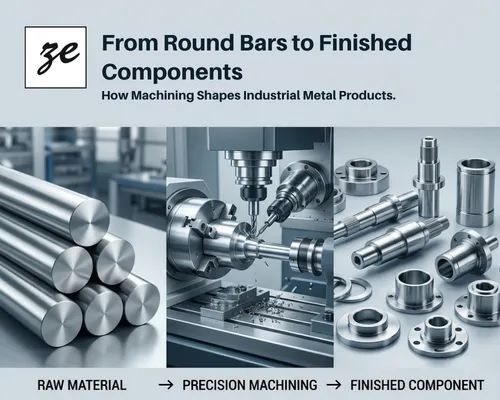
From Round Bars to Finished Components: How Machining Shapes Industrial Metal Products
When an industrial project needs a component that must fit precisely, withstand pressure, and perform reliably in demanding conditions, the quality of the raw material is only the beginning. Machining transforms that material into a finished product with the required dimensions, surface finish, threads, holes, and other features.
For industries working with corrosion-resistant materials, this process becomes even more important. Duplex Steel and Super Duplex Steel combine high strength with excellent corrosion resistance, making them suitable for oil & gas, marine, chemical processing, power generation, desalination, and other demanding applications. Zeon Exports supplies these materials and provides machining and customization solutions for industrial requirements.
Starting with the Right Round Bar
Many precision components begin as a solid metal bar. Round Bars are particularly useful because their cylindrical shape is well suited to turning and other machining operations. Depending on the component design, a round bar can be cut to length and then machined into shafts, pins, studs, bushings, sleeves, bolts, and other engineered parts.
For example, imagine an offshore equipment manufacturer requiring a corrosion-resistant shaft with several different diameters, a threaded section, and a precisely finished bearing area. Instead of producing the entire shape from scratch, the manufacturer can begin with a suitable Duplex or Super Duplex round bar and gradually remove material until the required geometry is achieved.
Zeon Exports supplies Duplex and Super Duplex round bars in different grades and sizes, including Alloy 2205 and Alloy 2507/F55. Custom cutting and machining are also available for specific requirements.
How Machining Changes Raw Material into a Component
Machining involves controlled material removal. The process may include several operations depending on the component drawing.
- Cutting is generally the first step. The bar is cut into a manageable length according to the required component size.
- Turning is then used to create cylindrical features. A CNC lathe can reduce the outside diameter, create steps, grooves, tapers, or other profiles with controlled accuracy.
- Drilling creates holes for bolts, pins, shafts, or fluid passages. The location and diameter of each hole must match the engineering drawing.
- Threading produces internal or external threads. This is particularly important for fasteners, connectors, fittings, and mechanical assemblies.
- Grinding can be used when a tighter dimensional tolerance or smoother surface is required. Zeon Exports lists cutting, turning, threading, drilling, and centerless grinding among its machining processes.
The result is not simply a piece of metal that has been cut. It is a component manufactured according to a defined drawing, specification, tolerance, and application requirement.
Why CNC Machining Matters
Modern CNC machining of metal components allows machines to follow programmed instructions with consistent movements. This is valuable when a project requires several hundred or several thousand components with the same dimensions.
Consider a manufacturer producing pump components. If every shaft has a slightly different diameter, assembly can become difficult and equipment performance may suffer. CNC machining helps maintain repeatability from one component to the next.
This is why precision machined components are widely used in applications where dimensional accuracy matters. The machining process can be planned around the material grade, component geometry, tolerance requirements, surface finish, and production quantity.
Duplex and Super Duplex steels require appropriate machining practices because their strength and work-hardening characteristics can influence cutting conditions. Selecting suitable tooling, speeds, feeds, coolant, and machining methods helps achieve a reliable result while controlling tool wear and surface quality.
Beyond Round Bars: Machining Different Metal Products
Although round bars are common starting materials, industrial manufacturing is not limited to them. Different components can begin with plates, pipes, fittings, flanges, or structural sections depending on the final design.
For fabricated or machined assemblies, Sheets & Plates may be cut and prepared for further manufacturing. Plates can be used for bases, covers, brackets, and other engineered parts.
Pipes & Tubes can also undergo cutting, end preparation, threading, or other operations when required for a piping system.
In piping applications, accurately manufactured Flanges and Fittings are essential for connecting equipment and maintaining proper alignment.
Similarly, Fasteners may require controlled threading, dimensions, and finishing to provide a dependable mechanical connection.
For larger structural applications, Structural Profiles can be cut and customized according to project requirements.
Industrial assemblies may also include Industrial Valves, where accurate component dimensions are important for proper operation and integration into a piping system.
From Drawing to Finished Product
Good industrial metal component manufacturing starts long before the cutting tool touches the material. Engineers first review the drawing, grade, dimensions, tolerances, quantity, and intended service conditions.
The raw material is then selected according to the specification. After cutting, machining operations are planned in a logical sequence to reduce errors and maintain dimensional control. Once machining is completed, the component can undergo inspection and testing according to customer requirements.
Zeon Exports also provides customization and testing services, including PMI, ultrasonic testing, dye penetration testing, hardness testing, tensile testing, and other inspection methods depending on the project.
This complete approach is useful when customers need more than raw material. Instead of purchasing a bar and arranging multiple manufacturing stages independently, they can source material and finished or semi-finished components through one experienced partner.
Why Machining Adds Value
The main advantage of machining is that it turns standard material into something ready for a specific application. A round bar may have excellent mechanical and corrosion-resistant properties, but a machine shaft, threaded stud, coupling, or precision pin requires a particular shape and dimensional accuracy.
For businesses, this can simplify procurement, reduce additional processing requirements, and improve production planning. It also allows components to be produced according to customer drawings rather than forcing the application to adapt to standard stock sizes.
For demanding industries, the combination of quality raw material and controlled machining can make a significant difference in component reliability and service life.
Choose Zeon Exports for Machined Metal Solutions
From a standard round bar to a finished precision component, every manufacturing stage contributes to the final performance of the product. Choosing the right material, machining method, dimensional controls, and inspection process helps ensure that the finished component is ready for its intended industrial application.
Zeon Exports combines extensive Duplex and Super Duplex Steel material availability with machining, customization, testing, and engineering support. This makes it a practical choice for businesses looking for reliable raw materials as well as finished industrial metal components.
- Address: A-7/9, Saboo Building, Ardeshir Dady Cross Lane, Cawasji Patel Tank Road, Mumbai – 400004
- Phone: +91 98205 33105
- Email: sales@zeonexports.com
- Website: www.zeonexports.com
Related Blog Posts
Custom Machined Stainless Steel & Alloy Components Supplier
Precision Machined Round Bars
FAQs
Q1. What materials can be used for machining industrial components?
Duplex Steel, Super Duplex Steel, stainless steel, nickel alloys, and other engineering materials can be machined depending on the component design and application requirements.
Q2. What is machining of round bars used for?
Machining of round bars is commonly used to manufacture shafts, pins, bushings, studs, bolts, sleeves, connectors, and other cylindrical precision components.
Q3. What is the advantage of CNC machining?
CNC machining provides repeatable and controlled manufacturing, making it suitable for components that require consistent dimensions, complex profiles, and close tolerances.
Q4. Can Zeon Exports provide custom machined components?
Yes. Zeon Exports provides customization and machining services based on customer requirements, technical drawings, and specifications.
Q5. Why are Duplex and Super Duplex steels used for industrial components?
These materials combine high mechanical strength with strong resistance to corrosion, making them useful for demanding environments such as offshore, oil & gas, chemical processing, marine, and desalination applications.