


How Corrosion Allowance Influences Stainless Steel Material Selection
When engineers select stainless steel for an industrial project, corrosion resistance is usually one of the first considerations. However, choosing a corrosion-resistant grade is not always enough. The expected rate of material loss during service must also be considered. This is where corrosion allowance stainless steel design becomes important.
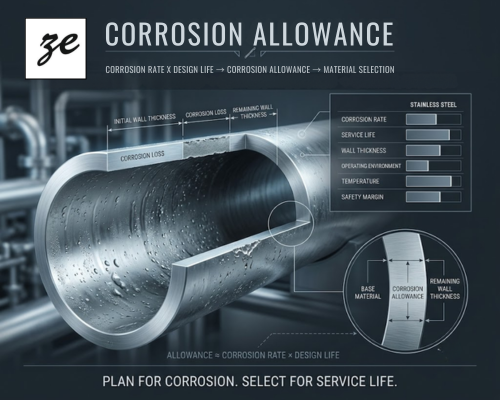
Corrosion allowance is the additional material thickness provided to compensate for the expected loss caused by corrosion during the planned service life of a component. Although stainless steel and duplex grades are highly corrosion resistant, they are not automatically immune to every corrosive environment. Chlorides, acids, seawater, chemicals, temperature, pressure, and stagnant conditions can all influence material performance.
For buyers and engineers working on pipelines, tanks, pressure equipment, offshore systems, and chemical processing equipment, understanding this relationship can make stainless steel material selection more reliable and cost-effective.
What Is Corrosion Allowance in Stainless Steel?
Corrosion allowance is essentially a design margin. If an engineer expects a component to lose a certain amount of metal during its operating life, additional thickness may be specified so that the component remains safe and functional.
For example, imagine a stainless steel plate is required to maintain a minimum thickness of 10 mm throughout its service life. If the calculated corrosion allowance is 2 mm, the starting thickness may need to be at least 12 mm, subject to the applicable design code, manufacturing tolerances, mechanical requirements, and other considerations.
However, corrosion allowance should not simply be added as an arbitrary number. It should be based on the expected environment, corrosion mechanism, operating conditions, inspection strategy, and design life.
Why Grade Selection Matters More Than Simply Adding Thickness
A common mistake is to assume that increasing thickness can compensate for poor material selection. It cannot always do so.
If an environment can cause localized corrosion such as pitting, crevice corrosion, or stress corrosion cracking, adding thickness may not solve the underlying problem. A component could still suffer localized damage even when significant metal remains elsewhere.
This is why corrosion resistant stainless steel grades must be selected according to the actual service environment.
For example, standard austenitic stainless steels may be suitable for many general applications, while duplex stainless steels such as Alloy 2205 offer a useful combination of strength and corrosion resistance. For more aggressive chloride-rich environments, super duplex grades such as Alloy 2507 may provide a higher level of corrosion resistance.
Zeon Exports supplies duplex and super duplex grades including Alloy 2205, Alloy 2304, Alloy 329, Alloy 2507/F53, Alloy 2507/F55, and Alloy 255.
How Corrosion Allowance Affects Stainless Steel Thickness
The relationship between corrosion allowance and thickness is particularly important for pressure-containing and structural components.
A project may initially require a specific wall thickness based on pressure, mechanical strength, temperature, fabrication requirements, and applicable design standards. The expected corrosion loss is then considered when establishing the required nominal thickness.
This is especially important for products such as Duplex Steel Sheets & Plates and Duplex Steel Pipes & Tubes, where wall thickness directly affects structural integrity and service performance.
The concept of stainless steel thickness corrosion allowance should therefore be evaluated together with manufacturing tolerances and the minimum allowable operating thickness. Engineers should also consider whether corrosion is expected to be uniform or localized.
Choosing the Right Grade for the Environment
The operating environment is one of the most important factors in industrial stainless steel material selection.
Consider a seawater piping system. It may experience high chloride exposure, moisture, temperature changes, and flow-related effects. Selecting a material solely because it is called "stainless steel" may not provide sufficient protection.
Duplex and super duplex steels are often considered for demanding applications because their alloy chemistry and two-phase microstructure provide a strong combination of mechanical strength and corrosion resistance. Zeon Exports notes that duplex steels are designed to provide strong resistance to chloride-related pitting and stress corrosion cracking compared with conventional austenitic grades.
For example, Alloy 2507/F53 Super Duplex Steel Sheets & Plates are positioned for demanding applications including oil and gas, offshore engineering, chemical processing, and water treatment.
Corrosion Allowance Across Different Components
Corrosion allowance does not affect every stainless steel product in exactly the same way.
For rotating and machined components, Duplex Steel Round Bars may be selected based on strength, corrosion resistance, machining requirements, and the environment in which the finished component will operate.
In piping systems, Duplex Steel Fittings and Duplex Steel Flanges must be compatible with the pipe material and service conditions. A mismatch between connected components can create maintenance and corrosion concerns.
Similarly, Duplex Steel Fasteners and Duplex Steel Industrial Valves need to be considered as part of the complete system rather than as isolated products.
For structural applications, Zeon Exports supplies structural profiles in forms such as square bars, hex bars, flat bars, angles, channels, and beams in duplex and super duplex grades.
Why Overestimating Corrosion Allowance Can Also Be a Problem
More corrosion allowance does not always mean better engineering.
Adding excessive thickness can increase material cost, component weight, fabrication requirements, transportation costs, and machining time. In applications where high-strength duplex or super duplex steel is used, selecting a suitable grade may allow engineers to achieve the required mechanical performance without simply making the component much thicker.
The objective should therefore be to find the right balance between material grade, corrosion resistance, thickness, design life, operating conditions, and total lifecycle cost.
A Practical Approach to Material Selection
Before finalizing a stainless steel grade, engineers should review:
- The chemical composition of the process fluid.
- Chloride and salt exposure.
- Operating and design temperature.
- Pressure and mechanical loading.
- Expected service life.
- Possible corrosion mechanisms.
- Required minimum operating thickness.
- Applicable design and material standards.
- Inspection and maintenance plans.
- Availability of the required grade, size, and form.
This approach helps prevent the common mistake of selecting material based only on purchase price. A material that costs slightly more initially may provide better lifecycle value when it reduces corrosion-related maintenance, downtime, and replacement.
Conclusion
Corrosion allowance is an important part of responsible stainless steel design, but it should never be treated as a substitute for correct material selection. The right approach combines environmental assessment, corrosion-rate evaluation, mechanical requirements, design life, thickness calculations, and the appropriate stainless steel grade.
For demanding industrial environments, duplex and super duplex steels can offer an attractive combination of high strength and corrosion resistance. Zeon Exports supplies a broad range of duplex and super duplex products for industries including oil and gas, marine, chemical processing, water treatment, energy, and fabrication.
When the application demands dependable performance, selecting the correct material at the beginning can be far more valuable than trying to compensate for an unsuitable grade later.
Frequently Asked Questions
Q1. What is corrosion allowance in stainless steel?
Corrosion allowance is additional material thickness provided to account for the expected loss of metal during a component's intended service life. The actual allowance depends on the environment, corrosion mechanism, design life, and applicable engineering requirements.
Q2. Does stainless steel always require a corrosion allowance?
Not necessarily. The requirement depends on the material, environment, design code, expected corrosion mechanism, and project specifications. Highly corrosion-resistant materials may require little or no conventional allowance in some applications, but this must be established through proper engineering assessment.
Q3. Can increasing stainless steel thickness prevent corrosion?
Increasing thickness can provide additional material for uniform corrosion loss, but it does not necessarily prevent localized corrosion such as pitting or crevice corrosion. Selecting an appropriate corrosion-resistant grade is therefore essential.
Q4. Which stainless steel grades are suitable for aggressive environments?
The correct grade depends on the specific environment. Duplex grades such as Alloy 2205 and super duplex grades such as Alloy 2507 are commonly considered for demanding chloride, marine, oil and gas, chemical, and water-treatment applications because of their strength and corrosion resistance.
Q5. How can I select the right stainless steel material for my project?
Start by evaluating the process environment, temperature, pressure, chemical exposure, chloride level, design life, required thickness, corrosion mechanisms, fabrication requirements, and applicable standards. A qualified materials or corrosion engineer should confirm the final selection for critical applications.
Contact Zeon Exports
Zeon Exports – Supplier of Duplex Steel & Super Duplex Steel
- Address: A-7/9, Saboo Building, Ardeshir Dady Cross Lane, Cawasji Patel Tank Road, Mumbai – 400004
- Phone: +91 98205 33105
- Email: sales@zeonexports.com
- Website: www.zeonexports.com
For duplex steel, super duplex steel, and other high-performance alloy requirements, contact Zeon Exports for material availability, specifications, documentation, and project requirements.