


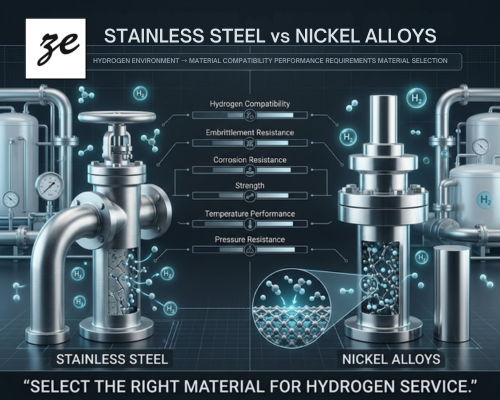
Material Selection for Hydrogen Applications: Stainless Steel vs Nickel Alloys
Hydrogen is becoming an important part of the global energy transition, with applications ranging from hydrogen production and storage to transportation, fuel systems, and industrial processing. But working with hydrogen requires careful material selection. Unlike many conventional gases, hydrogen can enter metals and affect their mechanical performance, making the choice of material an important part of system reliability.
For engineers and procurement teams, the decision often comes down to stainless steel vs nickel alloys for hydrogen. There is no single material that is ideal for every hydrogen system. Pressure, temperature, hydrogen purity, stress level, manufacturing method, corrosion environment, and expected service life all influence the final choice.
For a project requiring dependable raw materials, working with an experienced Supplier of Duplex Steel & Super Duplex Steel can also help ensure that the selected material is supplied with appropriate documentation, traceability, and dimensional consistency.
Why Material Selection Matters in Hydrogen Systems
Hydrogen can interact with metals through mechanisms such as hydrogen absorption and diffusion. Under certain conditions, this may contribute to reduced ductility, cracking, fatigue concerns, or other forms of degradation. The risk depends heavily on the alloy, microstructure, hydrogen pressure, temperature, loading conditions, and surface condition.
This is why simply choosing a material because it has high tensile strength or excellent corrosion resistance is not enough. Engineers need to evaluate the complete operating environment.
For example, a component operating at moderate pressure may have very different material requirements from a high-pressure hydrogen storage or transportation system. Welded components, threaded connections, valves, and pressure-containing parts may also require separate evaluation.
Stainless Steel for Hydrogen Applications
Stainless steels are widely considered for hydrogen equipment because they combine strength, corrosion resistance, availability, and relatively practical fabrication characteristics. Austenitic stainless steels such as 304L and 316L are commonly evaluated for hydrogen service because their ductile austenitic structure can provide useful resistance to hydrogen-related degradation under many operating conditions.
Duplex and super duplex stainless steels may also be considered where higher strength and corrosion resistance are required. Zeon Exports supplies duplex and super duplex grades such as Alloy 2205 and Alloy 2507 in multiple product forms.
For projects where material needs to be machined into components, Round Bar can be considered for shafts, machined parts, studs, and other components where the project specification permits the selected alloy.
However, stainless steel selection should never be based only on the material name. The exact grade, heat treatment, cold work, welding procedure, surface condition, and hydrogen exposure conditions should be assessed before approval.
Nickel Alloys for Hydrogen Service
Nickel alloys are another important option when hydrogen systems demand demanding combinations of strength, corrosion resistance, temperature performance, or resistance to aggressive process environments.
Grades such as Alloy 625, Alloy 718, Alloy 825, Alloy C276, Alloy 400, and Alloy K500 are available from Zeon Exports. The company supplies nickel alloys in forms including pipes, tubes, sheets, plates, fittings, flanges, and round bars.
Nickel alloys can become particularly attractive when hydrogen service is combined with high temperature, corrosive chemicals, or demanding mechanical requirements. However, "nickel alloy" is not automatically synonymous with "hydrogen compatible." Each grade must still be evaluated against the specific hydrogen environment and design conditions.
For example, Nickel Alloy Sheets & Plates can be useful for fabricated equipment and components where corrosion resistance and mechanical performance are important.
Stainless Steel vs Nickel Alloys for Hydrogen
The comparison between stainless steel and nickel alloys should focus on the actual operating conditions rather than simply comparing price or nominal strength.
Stainless steel can offer a practical balance of availability, fabrication, corrosion resistance, and cost. For many hydrogen systems, an appropriately selected stainless steel may provide the required performance without moving to a more expensive nickel alloy.
Nickel alloys, on the other hand, may provide advantages when the system combines hydrogen exposure with severe temperatures, aggressive chemicals, or demanding mechanical conditions. Their higher material cost can be justified when the application requires capabilities beyond those offered by conventional stainless steel.
A useful approach to materials selection for hydrogen systems is therefore to begin with the operating envelope and then compare candidate grades against that envelope.
Choosing the Right Product Form
Material selection does not end with choosing an alloy grade. The product form also matters.
Hydrogen piping systems may require Pipes & Tubes with suitable dimensions, manufacturing routes, and inspection requirements.
Connections require compatible Fittings and Flanges selected according to the pressure, temperature, joining method, and applicable specifications.
Mechanical connections may require suitable Fasteners, particularly where strength and corrosion resistance are important.
Flow-control equipment should also receive careful attention. Industrial Valves can form an important part of hydrogen piping and process systems, but valve materials, seals, seats, pressure ratings, and design should all be verified for the intended hydrogen service.
For supporting structures and fabricated assemblies, Structural Profiles may be specified where the project calls for corrosion resistance and structural strength.
A Practical Material Selection Approach
A reliable selection process should consider:
- Hydrogen pressure and temperature.
- Hydrogen purity and exposure duration.
- Static and cyclic loading.
- Corrosion and chemical exposure.
- Welding and fabrication requirements.
- Component geometry and manufacturing process.
- Applicable design codes and project specifications.
- Inspection, testing, and material traceability requirements.
Zeon Exports also provides testing services including PMI, ultrasonic testing, radiography, dye penetration testing, spectro analysis, tensile testing, and hardness testing according to material and customer requirements.
Ultimately, the best hydrogen compatible materials are those demonstrated to meet the complete requirements of the application. Stainless steel can be an economical and capable solution for many systems, while nickel alloys may be preferred for more severe combinations of hydrogen exposure, temperature, corrosion, and mechanical loading.
Why Choose Zeon Exports?
Zeon Exports specializes in Duplex Steel, Super Duplex Steel, Nickel Alloys, and other exotic alloys, with products available in multiple forms for industrial applications. Its product range includes round bars, sheets and plates, pipes and tubes, fittings, flanges, fasteners, valves, and structural profiles.
For hydrogen projects, material selection should be treated as an engineering decision—not simply a purchasing decision. The right grade, product form, manufacturing condition, testing, and documentation can make a significant difference to long-term system performance.
Frequently Asked Questions
Q1. What is the best stainless steel for hydrogen applications?
There is no universal best grade. Austenitic stainless steels such as 304L and 316L are commonly evaluated, but the appropriate choice depends on pressure, temperature, hydrogen concentration, stress, fatigue, and applicable standards.
Q2. Are nickel alloys better than stainless steel for hydrogen service?
Not necessarily. Nickel alloys can be advantageous in severe environments, but stainless steel may provide a more economical solution when its performance meets the project requirements.
Q3. Can duplex stainless steel be used in hydrogen systems?
Certain duplex grades may be considered depending on the application and service conditions. Their suitability should be confirmed through the applicable design requirements and material compatibility assessment.
Q4. What products are commonly required for hydrogen piping systems?
Depending on the system, requirements may include pipes and tubes, fittings, flanges, valves, fasteners, round bars, sheets and plates, and structural profiles.
Q5. What should engineers check before selecting a hydrogen-service material?
Engineers should review hydrogen pressure, temperature, purity, stress, cyclic loading, corrosion environment, welding condition, manufacturing process, applicable standards, and inspection requirements.
Contact Zeon Exports
Zeon Exports – Supplier of Duplex Steel & Super Duplex Steel
- Address: A-7/9, Saboo Building, Ardeshir Dady Cross Lane, Cawasji Patel Tank Road, Mumbai – 400004
- Phone: +91 98205 33105
- Email: sales@zeonexports.com
- Website: www.zeonexports.com