


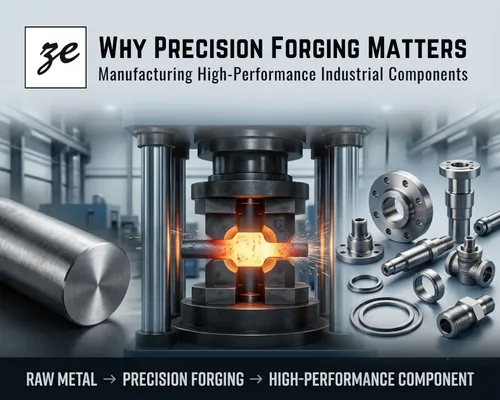
Why Precision Forging Matters When Manufacturing High-Performance Industrial Components
When an industrial component is expected to work under high pressure, heavy loads, extreme temperatures, or corrosive conditions, the manufacturing process matters just as much as the material itself. A component may be made from a high-quality alloy, but if its shape, grain structure, dimensions, or surface finish are not properly controlled, its performance can suffer.
This is where precision forging becomes important. Precision forging for industrial components combines controlled forming techniques with accurate dimensional requirements to produce strong, reliable, and consistent parts. For industries such as oil and gas, petrochemical, marine, power generation, chemical processing, and heavy engineering, this can make a major difference in component performance.
At Zeon Exports, the focus is on supplying high-quality Duplex Steel, Super Duplex Steel, Nickel Alloys, and other high-performance materials for demanding industrial applications. The company also supports manufacturing requirements involving precision components and customized solutions.
What Is Precision Forging?
Precision forging is a metal-forming process in which heated or specially prepared metal is shaped under controlled pressure using dies or tooling. Unlike conventional forging, precision forging focuses strongly on achieving close dimensional tolerances and reducing the amount of machining required after forging.
The process can be used to manufacture components with complex shapes while maintaining excellent material strength. The controlled deformation also helps develop a favourable grain flow, which can contribute to better mechanical performance.
For example, imagine an industrial valve component that must operate repeatedly under pressure. A small dimensional variation in a critical area can affect assembly, sealing, or service life. Precision manufacturing helps reduce these risks by producing components closer to their required final dimensions.
Better Strength and Material Performance
One of the main reasons manufacturers choose precision forged components is their mechanical strength. Forging compresses and shapes the metal rather than simply removing material from a larger block.
The resulting grain flow can follow the general shape of the component, helping improve its resistance to mechanical stresses. This is particularly useful for components exposed to impact, pressure, vibration, and repeated loading.
Duplex and Super Duplex steels are already valued for their combination of strength and corrosion resistance. Grades such as Duplex 2205 and Super Duplex 2507 can be particularly useful when both mechanical performance and resistance to aggressive environments are required.
For projects requiring suitable raw materials for machining or forging, Zeon Exports supplies products such as Round Bars, which can serve as an important starting material for manufacturing precision components.
Improved Dimensional Accuracy
Industrial components often need to fit with other parts without excessive adjustment. Precision forging helps manufacturers achieve consistent dimensions and tighter tolerances.
This can reduce the amount of machining required after forging. Less machining can mean reduced material wastage, shorter production cycles, and better manufacturing efficiency.
For large industrial projects, these benefits can become significant. Producing hundreds or thousands of similar components with consistent dimensions makes assembly easier and helps maintain predictable performance across the finished equipment.
Reduced Material Waste
Traditional machining can involve removing a substantial amount of metal from a billet, bar, or block to achieve the desired shape. Precision forging can produce a component much closer to its final geometry.
This near-net-shape approach can reduce material consumption and machining time. It is especially valuable when working with premium alloys where raw material costs are relatively high.
For manufacturers working with fabricated assemblies, Sheets & Plates can also provide suitable material options for applications requiring corrosion resistance, strength, and dependable fabrication characteristics.
Suitable for High-Performance Applications
High-performance forged parts are commonly required in environments where component failure can result in costly downtime, safety concerns, or production losses.
Oil and gas equipment, chemical processing systems, offshore structures, marine equipment, pressure-related components, and power-generation systems can all require materials and components capable of handling demanding service conditions.
Duplex and Super Duplex steels offer a useful combination of strength and corrosion resistance. When these materials are formed and manufactured correctly, they can provide dependable performance in challenging environments.
Zeon Exports supplies a broad range of products for such applications, including Pipes & Tubes, Flanges, and Fittings, helping customers source materials for complete industrial piping and engineering requirements.
Custom Precision Forging for Specific Requirements
Not every industrial project can use an off-the-shelf component. Equipment designers may require a specific diameter, thickness, geometry, tolerance, material grade, or machining allowance.
This is where custom precision forging becomes valuable. Components can be developed according to project drawings and technical requirements rather than forcing the application to fit a standard product.
Custom manufacturing can be particularly useful when replacing obsolete components, developing new equipment, or producing specialized parts for harsh operating environments.
The same approach applies to supporting components such as Fasteners, which may need to match the mechanical and corrosion-resistance requirements of the larger assembly.
Precision Forging and Corrosion-Resistant Materials
Material selection is a critical part of industrial component manufacturing. A component exposed to seawater, chlorides, chemicals, or high-temperature environments may require significantly greater corrosion resistance than a component used in a normal indoor application.
Super Duplex Steel is often considered for demanding environments because of its high strength and strong resistance to several forms of corrosion. However, material selection should always be based on the actual operating conditions, applicable standards, and engineering requirements.
For complete industrial systems, Zeon Exports also supplies Industrial Valves, which can be used in demanding flow-control applications.
Supporting Efficient Industrial Manufacturing
Precision forging is not only about making a stronger component. It can also contribute to an efficient production process.
Better dimensional control, reduced machining requirements, lower material waste, and repeatable production can help manufacturers improve overall manufacturing efficiency. When components are produced consistently, quality inspection and assembly can also become easier.
For structural applications, Structural Profiles provide another material category that can support demanding engineering and fabrication projects.
Quality Control Still Matters
Even the best forging process requires proper quality control. Material certificates, dimensional inspection, mechanical testing, heat treatment control, surface inspection, and traceability can all be important depending on the application.
For critical industrial components, buyers should clearly define the required material grade, standards, dimensions, testing requirements, and documentation before production begins.
Zeon Exports maintains quality-focused sourcing and supplies Duplex Steel, Super Duplex Steel, Nickel Alloys, and other exotic alloy products for demanding industrial requirements. Its product range includes materials suitable for machining, forging, fabrication, and engineered component manufacturing.
Why Choose Precision Forging?
The value of precision forging becomes clear when component reliability matters. It can provide:
- Improved dimensional accuracy
- Strong and consistent material properties
- Better grain flow than many conventional manufacturing approaches
- Reduced machining requirements
- Lower material wastage
- Repeatable component production
- Greater flexibility for custom designs
- Suitable solutions for demanding industrial environments
For manufacturers producing critical equipment, these advantages can translate into better productivity and more dependable finished products.
Contact Zeon Exports
- Address: A-7/9, Saboo Building, Ardeshir Dady Cross Lane, Cawasji Patel Tank Road, Mumbai – 400004
- Phone: +91 98205 33105
- Email: sales@zeonexports.com
- Website: www.zeonexports.com
For precision material requirements, custom component manufacturing support, or high-performance alloy requirements, contact Zeon Exports to discuss your project specifications.
*Product categories referenced above are based on Zeon Exports' listed product range. *
Related Blog Posts
Forged vs Cast Components: Which Is Better for Critical Industrial Applications?
Forged Stainless Steel Components Manufacturer
Frequently Asked Questions
Q1. What is precision forging used for? Precision forging is used to manufacture components that require high strength, dimensional accuracy, consistent quality, and reliable performance. It is widely used for demanding industrial and engineering applications.
Q2. What are precision forged components? Precision forged components are metal parts manufactured through a controlled forging process designed to achieve close dimensions and specific geometries while maintaining strong mechanical properties.
Q3. Why is precision forging suitable for Duplex and Super Duplex Steel? Duplex and Super Duplex steels combine high strength with corrosion resistance. Precision forging can help form these materials into strong, accurately shaped components for demanding applications when the correct forging and heat-treatment procedures are followed.
Q4. Can precision forging produce custom components? Yes. Custom precision forging can be used to manufacture components according to customer drawings, dimensions, material grades, tolerances, and application requirements.
Q5. How can Zeon Exports support industrial component requirements? Zeon Exports supplies Duplex Steel, Super Duplex Steel, Nickel Alloys, and other high-performance materials in forms including round bars, sheets and plates, pipes and tubes, fittings, flanges, fasteners, industrial valves, and structural profiles. These materials can support a wide range of manufacturing and engineering requirements.