


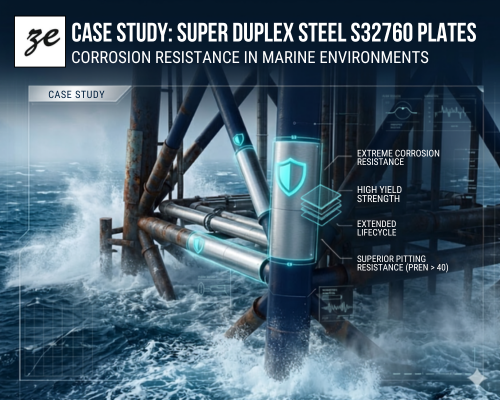
How Super Duplex Steel S32760 Plates Delivered Corrosion Resistance in Marine Environments
Super Duplex Steel S32760 Plates have become a preferred material for demanding marine applications where chloride-rich seawater, biofouling, and cyclic loading threaten structure life and reliability. This article explains why S32760 performs so well at sea, summarizes a real-world case study approach (S32760 Plate Case Study), compares it with conventional stainless steels, and explains why global buyers can rely on Zeon Exports for supply and support of high-performance corrosion resistant steel plates.
What Makes Super Duplex Steel S32760 Plates Ideal for Marine Applications
Super Duplex S32760 is a balanced duplex microstructure (austenite + ferrite) engineered for exceptional resistance to pitting, crevice corrosion, and stress corrosion cracking in chloride environments typical of marine service. Its chemistry—relatively high chromium, molybdenum and nitrogen—produces a high Pitting Resistance Equivalent Number (PREN), which predicts strong resistance to localized attack in seawater and splash zones. The alloy's higher yield strength compared with austenitic grades also allows thinner, lighter structures without compromising safety, an important advantage for ships and offshore platforms. Learn more about super duplex steel chemical composition and mechanical properties.
Key Properties of Super Duplex Steel S32760 Plates That Improve Corrosion Resistance
S32760's corrosion performance stems from three linked properties: a high PREN (pitting resistance), low susceptibility to chloride-induced stress corrosion cracking, and good crevice corrosion resistance in stagnant seawater conditions. The duplex microstructure provides rapid repassivation of damaged protective films and improved resistance to localized breakdown in chlorides. In addition, the alloy retains toughness at sub-zero temperatures and maintains mechanical integrity under cyclic loads—critical for hull fittings, propeller shafts, risers, and subsea hardware.
Case Study Overview: Marine Project Requirements and Challenges
A representative S32760 Plate Case Study focuses on a marine project requiring piping, pump casings, and seawater-exposed structural plates where traditional 316/316L failed by pitting and crevice corrosion within a few years. Project requirements included long-term resistance to seawater, minimal maintenance downtime, compatibility with seawater cooling systems, and reduced life-cycle cost. The primary challenges were high chloride exposure, mixed-metal galvanic risks, and confined-crevice geometries that concentrate corrosive attack. Read about corrosion challenges in marine pipelines solved with duplex steel.
Selection Process: Why Super Duplex Steel S32760 Plates Were Chosen
Engineers selected S32760 plates because the alloy's PREN and mechanical properties exceed those of common austenitic grades and many duplex alternatives, offering the safety margin needed for aggressive seawater conditions. Material selection also considered fabrication needs—weldability, post-weld heat treatment practices, and availability of certified plate thicknesses to meet pressure and structural design codes. Vendors with expertise in supply chain traceability, certification, and cut-to-size services were shortlisted to ensure consistent material quality.
Implementation and Performance Results in Real Marine Conditions
After installation, components fabricated from S32760 plates showed no evidence of active pitting or crevice corrosion in monitoring inspections over multiple years, unlike reference sites with 316L components. Routine non-destructive testing (visual, dye-penetrant and periodic ultrasonic checks) confirmed that welded joints and crevice-prone areas remained sound when appropriate welding procedures and post-weld practices were followed. The material's high strength allowed slimline designs that reduced weight while maintaining structural performance.
Corrosion Resistance Benefits Achieved After Installation
The marine installation delivered measurable benefits: extended service life with reduced replacement cycles, lower maintenance and coating costs, fewer unplanned outages, and improved safety margins under cyclic loading. The alloy's resistance to localized attack eliminated frequent repair interventions common with lower-grade stainless steels in the same environment. Over the project lifecycle, the higher initial material cost was offset by reduced maintenance, downtime, and total cost of ownership.
Comparison: Super Duplex Steel S32760 Plates vs Conventional Stainless Steel
Compared with conventional austenitic stainless steels such as 316/316L, S32760 offers substantially higher pitting and crevice resistance (higher PREN) and much higher yield strength, enabling thinner sections and lighter designs. Against standard duplex (e.g., 2205), S32760 typically gives improved resistance in the most aggressive chloride environments and higher creep and stress-corrosion performance, although at a higher material cost—justified when failure consequences or maintenance costs are high.
Long-Term Value and Operational Benefits for Marine Projects
Long-term value from S32760 plates comes through longer refurbishment intervals, predictable maintenance planning, and higher uptime for critical systems like seawater cooling, ballast systems, and subsea equipment. For owners, the alloy's performance reduces insurance and failure-risk exposure and supports sustainability goals by avoiding frequent material replacement and waste. When optimized in design and fabrication, S32760 often yields the lowest life-cycle cost for severe marine conditions.
Industries That Benefit from Super Duplex Steel S32760 Plates
Key industries that gain from S32760 plates include offshore oil & gas platforms, marine vessel construction, desalination plants, seawater-cooled power plants, subsea equipment manufacturers, and marine infrastructure like jetties and bridges exposed to splash zones. Any application where chloride-induced pitting, crevice corrosion or stress corrosion cracking are primary risks will see significant benefit from switching to super duplex solutions. Explore our range of super duplex steel products for marine applications.
Why Choose Zeon Exports for High-Performance Super Duplex Steel Solutions
Zeon Exports is a global supplier of high-performance alloys including duplex and super duplex steels, offering technical support, certification, and worldwide shipping for industrial projects. Choosing a supplier experienced in traceability, certified mill test reports, and tailored logistics ensures correct material selection and timely delivery—critical for marine projects with tight schedules. Zeon Exports provides contact channels for inquiries: WhatsApp +91 98205 33105 and Email sales@zeonexports.com for technical and commercial support. Visit our duplex steel plates supplier page for more information.
Order Super Duplex Steel S32760 Plates Today
Looking for a trusted partner for your steel requirements? Zeon Exports is ready to help.
- Email: sales@zeonexports.com
- Website: www.zeonexports.com
- Phone: +919820533105
Get in touch with our team for pricing, specifications, and quick delivery worldwide. Let us support your next project with reliable Super Duplex Steel S32760 Plates.
Related Blog Posts
Super Duplex Steel Plates for Extreme Service Conditions
Duplex Steel Plates vs Stainless Steel Plates
Frequently Asked Questions About Super Duplex Steel S32760 Plates
Q1. What is S32760 best used for in marine work?
S32760 is best for seawater-exposed equipment requiring high pitting and crevice resistance and strong mechanical performance, such as piping, heat exchangers, and subsea hardware.
Q2. How does S32760 compare to 316L in seawater?
S32760 has much higher pitting resistance and strength, giving longer life in chloride-rich conditions compared to 316L.
Q3. Are S32760 plates weldable for shipboard fabrication?
Yes—S32760 is weldable with controlled procedures and proper post-weld practice to preserve duplex balance and corrosion resistance.
Q4. Is S32760 cost-effective?
While more expensive upfront than common stainless steels, S32760 often offers lower life-cycle cost through reduced maintenance and longer service life in aggressive marine environments.
Q5. What inspection is recommended after installation?
Regular visual inspections, periodic non-destructive tests (UT, dye-penetrant), and monitoring of critical crevice zones are recommended to validate long-term performance.