


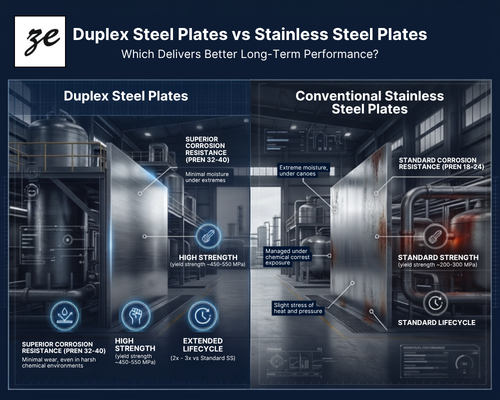
Duplex Steel Plates vs Conventional Stainless Steel Plates: Which Delivers Better Long-Term Performance?
Selecting the right steel plate matters most in environments where corrosion, pressure, temperature fluctuation, and downtime costs all add up over time. For high-corrosion industrial applications, the choice often comes down to duplex steel vs stainless steel plates, because both offer strong performance but deliver different long-term value.
Zeon Exports is positioned as a global supplier of high-performance alloy and steel products, with a focus on duplex steels, plates, long products, pipes, and precision industrial components. Their market presence emphasizes industrial sectors such as oil and gas, desalination, defense, automation, marine, and chemical processing, which makes this material comparison especially relevant.
Understanding Duplex Steel Plates and Their Composition
Duplex steel plates are stainless steels with a two-phase microstructure, combining austenite and ferrite in nearly balanced proportions. This structure is the reason long-term durability of duplex steel is often superior in aggressive environments, since it provides both higher strength and strong resistance to chloride-driven damage.
Compared with common austenitic stainless steels, duplex grades typically contain higher chromium, molybdenum, and nitrogen, and lower nickel. That chemistry supports improved pitting resistance, better crevice corrosion resistance, and stronger mechanical properties under demanding service conditions.
What Are Conventional Stainless Steel Plates?
Conventional stainless steel plates usually refer to familiar austenitic grades such as 304 and 316, which are widely used because they are versatile, easy to fabricate, and available in many industries. They perform well in many general-purpose applications, but their corrosion resistance and strength can be limiting in chloride-rich or highly corrosive environments.
That means conventional stainless steel can be the right choice for less severe service conditions, especially when cost, availability, and fabrication simplicity matter more than maximum durability. However, when the operating environment becomes harsher, the stainless steel plate performance comparison usually favors duplex.
Key Differences in Chemical Composition and Structure
The biggest difference between duplex and conventional stainless steel is microstructure. Duplex steel's dual-phase structure improves strength and makes it more resistant to stress corrosion cracking, especially in chloride-bearing environments, while austenitic stainless steels rely on a single-phase structure that is often more vulnerable in those conditions.
In practical terms, that structure affects how each material behaves under load and corrosion exposure. Duplex grades generally deliver a better balance of mechanical strength and corrosion resistance, which is why they are increasingly preferred in severe industrial service.
Mechanical Strength Comparison: Duplex vs Stainless Steel
From a strength standpoint, duplex typically outperforms conventional stainless steel by a wide margin. Published technical comparisons note that duplex grades often have significantly higher yield strength and tensile strength than common 316-type stainless steels, which can allow thinner sections and lighter designs without sacrificing performance.
This matters for fabrication and lifecycle planning because stronger plate can reduce material volume, installation burden, and some structural costs. For heavy-duty systems, the duplex steel plate advantages become especially clear when mechanical loading and corrosion exposure happen together.
Corrosion Resistance in Harsh and Marine Environments
Corrosion resistance is where duplex steel usually creates the strongest long-term case. In chloride-rich, marine, offshore, desalination, and chemical processing environments, duplex grades are known for superior resistance to pitting, crevice corrosion, and chloride stress corrosion cracking compared with standard austenitic stainless steels.
That is why the phrase Duplex vs conventional steel corrosion resistance matters so much in specification decisions. Conventional stainless steel performs adequately in many environments, but duplex is often the safer long-term choice when uptime, asset life, and maintenance reduction are critical. Read more about why duplex steel is replacing stainless steel? in demanding applications.
Cost Efficiency and Lifecycle Value Analysis
Duplex steel can cost more at the purchase stage, but long-term economics often favor it in harsh service. Its higher strength can reduce thickness requirements, and its corrosion resistance can lower repair, replacement, and maintenance frequency over the asset's life.
This is the core of the lifecycle argument: conventional stainless steel may look cheaper initially, but duplex often delivers better total value where corrosion is persistent. For plants and infrastructure exposed to seawater, chlorides, or aggressive process chemicals, the return on investment usually improves when fewer shutdowns and less corrosion damage occur. See how duplex steel helps reduce lifecycle costs in industrial projects.
Industry Applications: Where Each Material Performs Best
Duplex steel plates are especially strong in offshore platforms, desalination systems, chemical plants, pulp and paper equipment, marine structures, pressure vessels, and other environments with sustained corrosion exposure. These are the kinds of sectors where Zeon Exports' industrial focus aligns naturally with high-performance alloy supply.
Conventional stainless steel plates are still useful in food processing, architectural work, water systems with lower chloride exposure, and general industrial fabrication. In those environments, the corrosion load is lower, so the extra cost of duplex may not always be necessary.
Maintenance Requirements and Long-Term Durability Factors
Maintenance is another area where duplex often wins over time. Because it resists localized corrosion and stress cracking better, it usually requires less frequent inspection, fewer repairs, and lower replacement risk in aggressive service.
Long-term durability depends on design, welding practice, environment, and inspection discipline, but material selection remains the foundation. If the application involves salt, chemicals, humidity, and thermal stress together, duplex is generally the more robust option for sustained performance.
Final Verdict: Which Steel Plate Offers Better Long-Term Performance?
For high-corrosion industrial applications, duplex steel plates usually deliver better long-term performance than conventional stainless steel plates. The combination of high strength, strong pitting resistance, better chloride SCC resistance, and improved lifecycle value makes duplex the smarter material in severe environments.
Conventional stainless steel still has an important role where conditions are moderate and budget sensitivity is high, but it is not the best match for the most aggressive service conditions. For projects requiring dependable long-life performance, Duplex steel vs stainless steel plates is often not a close contest: duplex is usually the stronger long-term solution.
Order Duplex Steel Plates Today
Looking for a trusted partner for your steel requirements? Zeon Exports is ready to help.
- Email: sales@zeonexports.com
- Website: www.zeonexports.com
- Phone: +919820533105
Get in touch with our team for pricing, specifications, and quick delivery worldwide. Let us support your next project with reliable Duplex Steel Plates.
Related Blog Posts
Duplex Steel Plates Supplier for Global Industries
Why Duplex Steel Is Replacing Stainless Steel in Industrial Applications
Frequently Asked Questions About Duplex Steel Plates
Q1. What are duplex steel plates used for?
Duplex steel plates are used in offshore, marine, desalination, chemical, oil and gas, and other high-corrosion industrial applications.
Q2. Why are duplex steel plates stronger than conventional stainless steel plates?
Their balanced austenite-ferrite structure gives them higher yield and tensile strength than common austenitic stainless steels.
Q3. Are duplex steel plates more corrosion resistant than 316 stainless steel plates?
Yes, duplex grades generally provide better resistance to pitting, crevice corrosion, and chloride stress corrosion cracking.
Q4. Are duplex steel plates worth the extra cost?
In harsh environments, yes, because lower maintenance and longer service life often improve total lifecycle value.
Q5. Does Zeon Exports supply duplex steel products globally?
Zeon Exports presents itself as a global high-performance supplier serving industrial sectors and offering duplex steels, plates, and related products.