


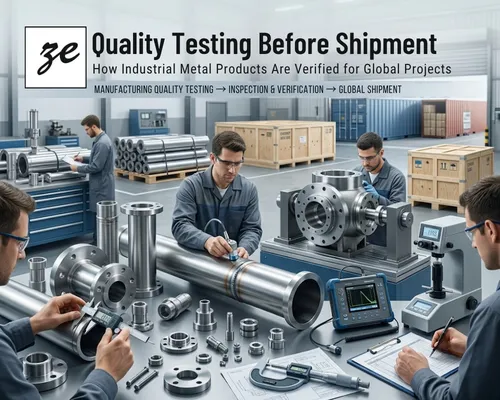
Quality Testing Before Shipment: How Industrial Metal Products Are Verified for Global Projects
When an industrial metal order is shipped to another country, quality cannot be checked only after the material reaches the project site. By that point, returning or replacing the material can cause delays, additional freight costs and serious project disruption.
For EPC contractors, procurement teams and engineering companies, industrial metal quality testing is therefore an important part of the purchasing process. Before shipment, materials are checked against the purchase order, technical specifications, applicable standards and project requirements.
At Zeon Exports, quality assurance is an important part of supplying Duplex Steel, Super Duplex Steel and other exotic alloy products for demanding industrial applications. The company supplies products including Round Bars, Sheets & Plates and Pipes & Tubes, along with finished industrial components.
1. Checking the Material Grade and Specification
The first step is confirming that the supplied material is actually the grade ordered by the customer.
For example, Duplex Steel 2205 and Super Duplex Steel 2507 may look similar to the naked eye, but their chemical composition and performance characteristics are different. The inspection process verifies the material designation, dimensions, applicable standard and heat or batch identification.
The inspection team also compares the actual material against the customer's purchase order and technical documentation. This simple step helps prevent incorrect grades, sizes or quantities from moving forward to shipment.
2. Chemical Composition Testing
Chemical analysis is one of the most important parts of material testing and certification.
A material sample can be tested using techniques such as spectro analysis to confirm the percentage of key elements. Depending on the grade, elements such as chromium, nickel, molybdenum, nitrogen and other alloying constituents are checked against the specified requirements.
This is especially important for Duplex and Super Duplex steels because their corrosion resistance and mechanical performance depend heavily on the correct chemical balance.
Zeon Exports states that its testing capabilities include spectro analysis and Positive Material Identification (PMI), depending on material and customer requirements.
3. Positive Material Identification (PMI)
PMI provides an additional layer of confidence that the material being prepared for shipment matches the specified grade.
During PMI, the composition of the material is checked using suitable identification equipment. The process can be particularly valuable for projects involving multiple alloy grades, where material mix-ups could create major problems during installation.
For large orders, heat numbers and identification markings are also important because they help maintain traceability between the physical material and its corresponding quality documents.
4. Mechanical Property Testing
Chemical composition alone does not tell the complete story. Industrial metals may also need to meet specific mechanical requirements.
Depending on the product, specification and project requirements, tests can include:
- Tensile testing
- Hardness testing
- Yield strength verification
- Elongation testing
- Other mechanical examinations specified by the applicable standard
These checks help establish whether the material has the required strength and performance characteristics for its intended service.
For example, a structural component, pressure piping system and offshore application may have very different mechanical requirements. That is why inspection is normally based on the project specification rather than applying one identical testing procedure to every product.
5. Dimensional and Visual Inspection
Before shipment, the physical condition of the product also needs to be checked.
Inspectors may verify length, diameter, thickness, outside diameter, wall thickness, flange dimensions, fitting dimensions and other parameters according to the product type.
For example, Flanges require dimensional checks for items such as outside diameter, bolt-hole arrangement, thickness and facing. Similarly, Fittings need to be checked for dimensions, shape and applicable specifications.
Visual inspection can identify surface imperfections, handling damage, unacceptable marks or other visible concerns before packing begins.
6. Non-Destructive Testing
Some projects require more detailed inspection without damaging the material. This is where non-destructive testing (NDT) becomes useful.
Depending on the product and specification, testing can include:
- Ultrasonic Testing (UT)
- Radiographic Testing (RT)
- Dye Penetrant Testing (DP)
- Other customer-specified NDT methods
Zeon Exports lists PMI, UT, radiography, dye penetration testing, spectro analysis, tensile testing and hardness testing among its available testing services, based on material and customer requirements.
For piping and fabricated components, NDT can provide additional confidence that the material or component meets the required inspection criteria.
7. Mill Test Certificates and Traceability
A quality inspection is not complete without proper documentation.
Mill Test Certificates (MTCs) provide important information about the supplied material, including grade, chemical composition, mechanical properties, heat number and applicable standards. Zeon Exports states that its products can be supplied with certified quality documentation and material traceability.
For international projects, documentation is particularly important because procurement teams, consultants, inspectors and end users may all need to review the same records.
For products such as Fasteners, documentation helps establish that the supplied grade and specification correspond with the project requirement.
8. Third-Party Inspection for Industrial Metals
Some global projects require an independent inspection agency to verify the material before dispatch. This is known as third-party inspection for industrial metals.
A third-party inspector may review documentation, witness testing, check dimensions, verify markings, inspect packing and prepare an inspection report. The exact inspection scope depends on the customer's Inspection and Test Plan (ITP), purchase order and project requirements.
This additional verification can be particularly useful for large oil and gas, petrochemical, power, marine and infrastructure projects where material quality and documentation must meet strict approval procedures.
9. Final Pre-Shipment Inspection
The final stage is the pre-shipment inspection for metal products.
Before the material leaves the supplier's facility, the order may be checked against:
- Purchase order quantity
- Product description and grade
- Dimensions and sizes
- Heat or batch numbers
- Test reports and certificates
- Inspection reports
- Marking and identification
- Packing requirements
- Shipping and documentation requirements
This final review acts as a practical checkpoint. It helps ensure that the material leaving the warehouse is the same material that was approved during the quality process.
For products such as Industrial Valves and Structural Profiles, inspection requirements can vary according to the project specification, so buyers should confirm the required inspection scope before placing the order.
Quality Inspection for Global Metal Projects
For international buyers, quality is about more than simply receiving metal products on time. The material must be suitable for the application, correctly identified, properly documented and packed for transportation.
Zeon Exports supplies Duplex Steel, Super Duplex Steel, Nickel Alloys and other exotic alloy products for industries including oil and gas, offshore, chemical processing, power generation, marine and water treatment. Its quality approach includes testing, documentation, traceability and project-specific inspection support.
A well-planned inspection process reduces uncertainty before the material leaves the supplier. It also gives project teams greater confidence that their materials are ready for fabrication, installation or further processing when they arrive at the destination.
Frequently Asked Questions
Q1. What is industrial metal quality testing? Industrial metal quality testing involves checking a product's chemical composition, mechanical properties, dimensions, surface condition and other requirements against applicable standards and project specifications.
Q2. What documents are normally supplied with industrial metals? Depending on the order, documentation can include Mill Test Certificates, test reports, inspection reports, dimensional records, PMI reports and other certificates required by the customer or project.
Q3. When is third-party inspection required? Third-party inspection is commonly required when a project specification, purchase order or end customer asks for independent verification before shipment. The inspection scope is normally agreed in advance.
Q4. Can Duplex and Super Duplex Steel be tested before shipment? Yes. Depending on the grade and customer requirements, testing can include PMI, chemical analysis, tensile testing, hardness testing and applicable NDT methods.
Q5. Why is pre-shipment inspection important for international projects? It helps identify quality, dimensional, documentation and identification issues before the material is dispatched, reducing the risk of delays, rejected materials and costly corrective action at the project site.
Get in Touch with Zeon Exports
If you are sourcing certified Duplex Steel, Super Duplex Steel or other industrial metal products for an international project, Zeon Exports can support your requirements with product supply, testing and documentation based on project specifications.
Zeon Exports Contact Details
- Address: A-7/9, Saboo Building, Ardeshir Dady Cross Lane, Cawasji Patel Tank Road, Mumbai – 400004
- Phone: +91 98205 33105
- Email: sales@zeonexports.com
- Website: https://www.zeonexports.com/
For global projects, the right material is only part of the requirement. Verified quality, accurate documentation and reliable traceability help ensure that the material is ready for its intended industrial application before it begins its journey.