


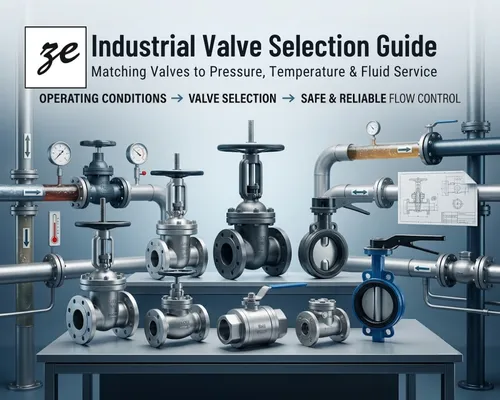
Industrial Valve Selection Guide: Matching Valves to Pressure, Temperature and Fluid Service
Selecting the right valve is an important part of designing a safe and reliable industrial piping system. A valve may look like a simple component, but its material, pressure rating, temperature capability, size, end connection and internal design all affect how well it performs. Choosing a valve only by pipe size or price can lead to leakage, premature wear, maintenance problems and even process failure.
This industrial valve selection guide explains the main factors engineers and purchasing teams should consider when selecting valves for industrial applications. From chemical processing and oil and gas to water treatment and power generation, the right valve should match the actual operating conditions of the system.
Start With the Fluid Service
The first question in valve selection should always be: What fluid will pass through the valve?
Water, steam, oil, gas, chemicals, slurry and corrosive liquids can behave very differently. Some fluids may attack the valve body or trim, while others may contain suspended particles that cause erosion. Chloride-rich seawater, for example, requires materials with strong corrosion resistance, particularly in demanding marine and desalination environments.
For aggressive services, corrosion-resistant materials such as Duplex Steel and Super Duplex Steel can be considered where their properties match the process requirements. Zeon Exports supplies a range of alloy products for demanding industrial environments, including Round Bars, Sheets & Plates, and Pipes & Tubes.
The fluid's viscosity, cleanliness, corrosiveness and temperature should also be reviewed before deciding on the valve design.
Match the Valve to Operating Pressure
Pressure is one of the most important considerations in pressure temperature valve selection. The valve must have a pressure rating suitable for the maximum pressure the system can experience, not simply its normal operating pressure.
For example, a process line normally operating at moderate pressure may experience higher pressure during startup, shutdown or abnormal operating conditions. Engineers should therefore review the design pressure, operating pressure and possible pressure surges before choosing the valve class or pressure rating.
The valve rating should also be considered together with temperature. A material or valve design that performs well at room temperature may have a different allowable pressure at elevated temperatures.
Flanges and fittings also form part of this pressure boundary. Zeon Exports provides Flanges and Fittings alongside industrial metal products, helping projects coordinate compatible piping components.
Consider Temperature Conditions
Temperature can significantly affect valve performance. High-temperature steam, hot oil, chemical processing fluids and heated gases require valve materials and sealing systems designed for those conditions.
When reviewing industrial valves for high pressure and temperature, consider both the maximum and minimum temperatures. Extreme heat can affect seals, gaskets and mechanical properties, while very low temperatures can create brittleness concerns in unsuitable materials.
A common mistake is selecting a valve based only on the temperature of the fluid during normal operation. Startup, shutdown, cleaning cycles and process fluctuations should also be considered.
Choose the Correct Valve Type
Different valve designs perform different jobs.
Ball valves are commonly selected when quick shut-off and relatively unrestricted flow are important. They are often suitable for on/off service.
Gate valves are generally used for isolation rather than frequent throttling. When fully open, they can provide a relatively straight flow path.
Globe valves can be useful where flow regulation is required. Their internal design allows better control than many isolation-focused valve types.
Check valves help prevent reverse flow and are commonly installed in systems where backflow could damage equipment or disrupt the process.
Butterfly valves can provide a compact solution for larger pipelines and are commonly used for isolation or control depending on the design.
The correct choice depends on the application rather than simply selecting the most popular valve type. Zeon Exports includes Industrial Valves among its product range, supporting applications where material and component selection are important.
Check Material Compatibility
Material selection becomes particularly important when the valve handles corrosive or chemically aggressive fluids. The body, stem, trim and other wetted components must be compatible with the service.
Duplex and Super Duplex stainless steels are often considered for applications requiring a combination of strength and corrosion resistance. Zeon Exports works with Duplex Steel and Super Duplex Steel grades including Alloy 2205, Alloy 2304, Alloy 329, F53, F55 and Alloy 255.
For components manufactured from bar material, Duplex Steel Round Bars and Super Duplex Steel round bars can be relevant where machining is required.
Material compatibility should always be confirmed against the actual fluid chemistry, concentration, pressure and temperature rather than relying only on the alloy name.
Do Not Ignore Connections and Piping Components
A valve is only one part of a complete piping system. The connection type must match the surrounding pipeline. Depending on the application, valves may use flanged, threaded, welded or other connection arrangements.
Incorrectly matched components can create installation difficulties and leakage risks. This is why supporting products such as Fasteners, Flanges and Fittings should be considered during the same project review.
For fabricated structures and equipment support, Structural Profiles can also form part of the wider material requirement.
Think About Maintenance and Service Life
Good valve selection for industrial applications should consider the complete operating life of the equipment. Ask how often the valve will operate, whether it needs regular inspection, how accessible it will be and what type of maintenance is expected.
For example, a valve installed in a difficult-to-access offshore location may require a different approach from one installed in an easily accessible utility room. Reliability, spare availability, inspection requirements and replacement costs should all be considered.
Documentation is equally important. Depending on the project, buyers may require material certificates, inspection reports, dimensional checks or testing documentation. Zeon Exports states that its testing capabilities include PMI, ultrasonic testing, radiography, dye penetration, spectro analysis, tensile testing and hardness testing according to material and customer requirements.
A Practical Valve Selection Checklist
Before finalizing a valve, review:
- Fluid type and chemical composition
- Normal and maximum operating pressure
- Normal, minimum and maximum temperature
- Required flow rate and pipe size
- Valve function: isolation, throttling or backflow prevention
- Body and trim material compatibility
- Pressure class and connection type
- Sealing requirements
- Operating frequency
- Maintenance and inspection requirements
- Applicable project and industry standards
- Testing and material documentation
A valve selected after reviewing all these factors is much more likely to provide dependable performance throughout its intended service life.
Frequently Asked Questions
Q1. What is the most important factor in industrial valve selection?
There is no single factor. Fluid service, pressure, temperature, valve function and material compatibility should all be evaluated together.
Q2. How does temperature affect valve selection?
Temperature can affect material strength, pressure capability and sealing performance. The valve should be selected according to the complete operating temperature range, including process variations.
Q3. Which valves are suitable for high-pressure applications?
Ball, gate, globe and other valve types can be designed for high-pressure service. The appropriate choice depends on the fluid, required function, pressure rating, temperature and applicable standards.
Q4. Why is material compatibility important?
If the valve material is unsuitable for the process fluid, corrosion, erosion or premature component failure may occur. Material selection should be based on actual service conditions.
Q5. Can Duplex or Super Duplex Steel be used for industrial valves?
Duplex and Super Duplex grades can be suitable for demanding applications where high strength and corrosion resistance are required. However, the final grade should always be selected according to the specific fluid, temperature, pressure and design requirements.
Conclusion
Choosing the right industrial valve is about more than selecting a size and pressure class. A reliable system begins with understanding the fluid, pressure, temperature, flow requirements and material compatibility. By evaluating these conditions together, engineers and procurement teams can make better decisions and reduce the risk of leakage, corrosion, unexpected downtime and premature replacement.
As a Supplier of Duplex Steel & Super Duplex Steel, Zeon Exports supports industrial projects with a broad range of alloy products, including Round Bars, Sheets & Plates, Pipes & Tubes, Flanges, Fittings, Fasteners, Industrial Valves and Structural Profiles. Its product portfolio and testing capabilities are designed to support demanding industrial requirements.
Zeon Exports Contact Details
- Address: A-7/9, Saboo Building, Ardeshir Dady Cross Lane, Cawasji Patel Tank Road, Mumbai – 400004
- Phone: +91 98205 33105
- Email: sales@zeonexports.com
- Website: https://www.zeonexports.com/