


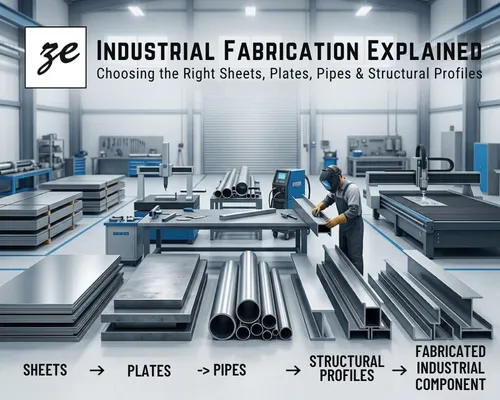
Industrial Fabrication Explained: Choosing the Right Sheets, Plates, Pipes and Structural Profiles
Industrial fabrication is the process of turning metal materials into useful components, structures, equipment, and assemblies for demanding industrial applications. From pressure vessels and storage tanks to piping systems, platforms, frames, and process equipment, the quality of the raw material plays an important role in the final product.
For fabricators, choosing the right material is not simply about selecting the strongest steel available. The correct choice depends on the application, operating environment, required dimensions, fabrication method, corrosion exposure, pressure, temperature, and applicable standards. This is especially important when working with Duplex and Super Duplex stainless steels, which are valued for their combination of strength and corrosion resistance.
Understanding the Role of Sheets and Plates in Fabrication
Sheets and plates are among the most commonly used industrial fabrication materials. They can be cut, bent, rolled, welded, and formed into different shapes depending on the project.
The difference between a sheet and a plate is primarily related to thickness. Sheets are generally used where thinner sections are required, while plates are preferred for heavier fabrication and structural applications.
In industries such as oil and gas, chemical processing, marine engineering, desalination, and power generation, fabricators may need materials that can withstand corrosive environments while maintaining mechanical strength. Duplex Steel grades such as Alloy 2205 are often considered for these requirements because they provide a useful balance of strength and corrosion resistance.
For projects requiring higher corrosion resistance in aggressive environments, Super Duplex grades such as Alloy 2507 may be considered. Zeon Exports supplies Sheets & Plates in Duplex and Super Duplex grades for demanding industrial applications.
Choosing the Right Steel Sheets and Plates
When choosing the right steel sheets and plates, fabricators should begin with the service conditions rather than the material name alone.
Consider the following factors:
- Required thickness and dimensions
- Design pressure and temperature
- Exposure to seawater, chemicals, chlorides, or moisture
- Welding and forming requirements
- Required mechanical properties
- Applicable ASTM, ASME, EN, or other standards
- Material certification and traceability
For example, a fabrication project located near the coast may face chloride-rich conditions that can accelerate corrosion. Selecting a suitable Duplex or Super Duplex grade at the design stage can help improve long-term performance.
Pipes and Tubes for Industrial Fabrication
Pipes and tubes perform a different function from flat products. They are primarily used to transport liquids, gases, chemicals, steam, and other process media or to create tubular structures.
The correct pipe selection requires attention to nominal pipe size, outside diameter, wall thickness, schedule, pressure requirements, manufacturing type, and end connection.
Zeon Exports offers Pipes & Tubes in Duplex and Super Duplex grades for industrial applications. Alloy 2205, for instance, is used in applications where high strength and corrosion resistance are important. For more aggressive environments, Super Duplex Alloy 2507/F53 can provide enhanced corrosion resistance.
A practical example is a chemical processing plant where a pipe carries a corrosive fluid. Choosing a pipe only by diameter may create problems later. The fabricator must also consider the fluid chemistry, pressure, temperature, wall thickness, welding requirements, and corrosion resistance of the selected grade.
Structural Steel Profiles for Fabrication
Structural profiles provide the framework that supports equipment, platforms, walkways, frames, and other fabricated structures. Depending on the design, profiles can include angles, channels, beams, flat bars, square bars, and other sections.
The selection of Structural Profiles should be based on the required load-bearing capacity, dimensions, design configuration, environmental exposure, and fabrication method.
In a marine or offshore project, for example, structural components may be exposed to moisture and saltwater. Using a material with appropriate corrosion resistance can be important for service life and maintenance requirements.
Why Fabricators Also Need Bars, Fittings, Flanges and Fasteners
A fabrication project rarely uses only sheets, plates, pipes, and profiles. Different components must work together to create a complete system.
Round Bars can be machined into shafts, pins, bolts, and other precision components. Fittings are used to connect or redirect piping, while Flanges provide detachable connections between pipes, valves, and equipment.
Fasteners are also essential for securing fabricated components, especially where bolted connections are preferred. Similarly, Industrial Valves help control, isolate, or regulate the flow of fluids in process systems.
Using compatible materials throughout the fabrication package is important. Mixing materials without considering corrosion, temperature, galvanic effects, or mechanical requirements can reduce overall system reliability.
A Practical Approach to Material Selection
A good material-selection process starts with the project drawing and operating conditions. The fabricator should identify what each component needs to do before deciding which product form is appropriate.
For a typical process skid, for example, plates may be used for base structures, profiles for supporting frames, pipes for fluid movement, fittings for directional changes, flanges for connections, fasteners for assembly, and valves for flow control.
The next step is checking dimensions, specifications, grade requirements, certificates, inspection requirements, and delivery schedules. Zeon Exports also provides material sourcing, customization, testing, documentation, and packaging support for industrial requirements.
Why Material Quality Matters in Industrial Fabrication
A fabrication project can look perfect after welding and finishing, but its long-term performance depends heavily on the material selected at the beginning. Incorrect grade, thickness, dimensions, or documentation can create costly rework and delays.
This is why fabricators should work with materials supported by proper documentation and traceability. Zeon Exports states that its Duplex and Super Duplex products are supplied with quality documentation and offers testing services such as PMI, ultrasonic testing, radiography, dye penetration testing, tensile testing, and hardness testing according to requirements.
Conclusion
Choosing the right industrial fabrication materials requires more than comparing prices. Sheets and plates must match the design and forming requirements, pipes and tubes must suit the process conditions, and structural profiles must provide the required support and durability.
For demanding environments, Duplex and Super Duplex stainless steels can offer a strong combination of mechanical performance and corrosion resistance. By selecting the appropriate grade, product form, dimensions, standards, and supporting components, fabricators can build reliable systems designed for long-term service.
Zeon Exports supports industrial requirements with a broad range of Duplex Steel, Super Duplex Steel, Nickel Alloys, and other exotic alloy products, including round bars, sheets and plates, pipes and tubes, structural profiles, fittings, flanges, fasteners, and industrial valves.
Zeon Exports Contact Details
- Address: A-7/9, Saboo Building, Ardeshir Dady Cross Lane, Cawasji Patel Tank Road, Mumbai – 400004
- Phone: +91 98205 33105
- Email: sales@zeonexports.com
- Website: https://www.zeonexports.com/
For enquiries about Duplex Steel, Super Duplex Steel, sheets and plates, pipes and tubes, structural profiles, fittings, flanges, fasteners, valves, or custom industrial requirements, contact Zeon Exports.
Related Blog Posts
Duplex Steel Sheet, Coil & Plate Supplier
Duplex Steel Plates Supplier for Global Industries
Frequently Asked Questions
Q1. What materials are commonly used in industrial fabrication?
Common materials include sheets, plates, pipes, tubes, structural profiles, round bars, fittings, flanges, fasteners, and valves. The selection depends on the application, environment, load, pressure, temperature, and required standards.
Q2. How do I choose the right steel sheets and plates?
Consider thickness, dimensions, operating temperature, pressure, corrosion exposure, fabrication process, welding requirements, mechanical properties, and applicable standards before selecting the grade.
Q3. When should Duplex Steel be used for fabrication?
Duplex Steel can be considered when a project requires a combination of high mechanical strength and good corrosion resistance. Alloy 2205 is one commonly used Duplex grade for demanding industrial applications.
Q4. What is the difference between pipes and structural profiles?
Pipes are primarily designed to carry fluids or gases, while structural profiles are generally used to create supporting frames, platforms, beams, channels, and other load-bearing structures.
Q5. Why are material certificates important in fabrication?
Material certificates provide important information about the supplied material and help confirm grade, mechanical properties, chemical composition, and traceability. They are particularly important for critical industrial projects where documentation and compliance are required.