


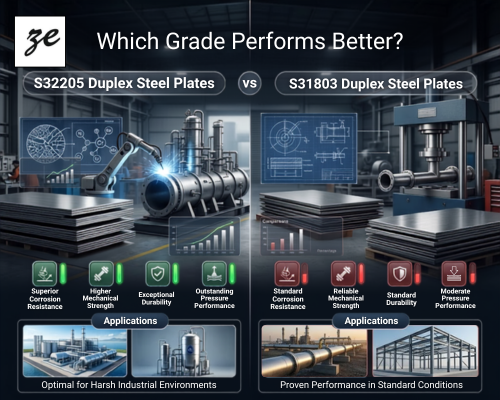
Duplex Steel S32205 Plates vs S31803 Plates – Which Grade Performs Better?
When selecting duplex stainless steel for demanding industrial applications, the choice often comes down to Duplex Steel S32205 Plates and Duplex Steel S31803 Plates. Both grades belong to the 2205 duplex family and offer a strong balance of corrosion resistance, mechanical strength, and durability, but S32205 vs S31803 Plates comparison shows that S32205 generally delivers tighter chemistry control and more consistent performance. For buyers looking for a reliable Duplex Steel Plate Supplier, this distinction can make a real difference in long-term service life.
Zeon Exports is positioned as a supplier of high-performance duplex steel and super duplex steel products, making it important to present accurate, technically sound, and search-friendly content. This article explains the differences so engineers, procurement teams, and industrial buyers can choose the right plate grade for their project.
What Are Duplex Steel S32205 Plates?
Duplex Steel S32205 Plates are a modern duplex stainless steel grade designed for excellent resistance to corrosion and high mechanical strength. They are widely used in chemical processing, marine environments, pressure vessels, oil and gas systems, and structural applications where both strength and corrosion resistance matter. As a Duplex Steel S32205 Plate Manufacturer product category, these plates are preferred when projects demand stable chemistry and dependable field performance.
S32205 is often considered an improved version of the earlier 2205 composition. It typically offers better control over nitrogen content, which helps improve corrosion resistance and mechanical properties. That makes it a smart option for critical applications where material reliability is essential.
What Are Duplex Steel S31803 Plates?
Duplex Steel S31803 Plates are the earlier duplex stainless steel designation in the 2205 family. They are also known for high strength, stress corrosion cracking resistance, and solid performance in aggressive environments. These plates are still widely used and remain a trusted choice for many industrial projects.
However, compared with S32205, the S31803 chemistry range is broader. That means the material may vary more from mill to mill, which can affect performance consistency. In practical use, this is the main reason many buyers now prefer S32205 when stricter material control is required.
S32205 vs S31803 Plates
The main difference in S32205 vs S31803 Plates lies in the chemistry limits and resulting performance consistency. S32205 was created to provide tighter control of composition, especially nitrogen and chromium, which improves pitting resistance and overall reliability. S31803 still performs well, but S32205 is generally regarded as the more advanced and better-controlled grade.
Here is a simple comparison:
| Property | Duplex Steel S31803 Plates | Duplex Steel S32205 Plates |
|---|---|---|
| Corrosion resistance | Good | Better and more consistent |
| Mechanical strength | High | High with improved stability |
| Chemical control | Wider range | Tighter, more controlled |
| Weldability | Good | Very good |
| Industrial preference | Standard duplex applications | Critical and high-performance applications |
For most modern projects, S32205 is preferred because it offers stronger confidence in performance under demanding operating conditions. S31803 remains useful where standard duplex service is acceptable and procurement flexibility is important.
Which Grade Performs Better?
In direct performance terms, Duplex Steel S32205 Plates usually perform better than Duplex Steel S31803 Plates because of the refined chemistry and better corrosion resistance. This makes S32205 a stronger choice for chloride-rich environments, marine exposure, offshore equipment, and chemical processing units. If the application is severe or the cost of failure is high, S32205 is usually the safer option.
S31803 can still be a practical and cost-effective choice for general industrial use. But if the goal is maximum reliability, improved resistance to localized corrosion, and a more consistent product standard, S32205 is typically the better grade. That is why many buyers searching for a Duplex Steel Plate Supplier now ask specifically for S32205 plates.
Why Choose Zeon Exports
Zeon Exports is presented as a supplier of high-performance duplex steel and super duplex steel, which fits customers who need durable alloy solutions for demanding industries. The company is associated with high-performance alloy pipes, fittings, duplex steel, super duplex steel, and related industrial products.
Order Duplex Steel Plates Today
Looking for a trusted partner for your steel requirements? Zeon Exports is ready to help.
- Email: sales@zeonexports.com
- Website: www.zeonexports.com
- Phone: +919820533105
Request a quotation for Duplex Steel S32205 Plates, Duplex Steel S31803 Plates, and other high-performance duplex steel products today.
Related Blog Posts
Duplex Steel Plates vs Stainless Steel Plates: Which Is Better for Your Industry?
Super Duplex Steel Plates for Extreme Service Conditions
Frequently Asked Questions About Duplex Steel S32205 vs S31803 Plates
Q1. What is the main difference between S32205 and S31803?
S32205 has tighter chemical control and better corrosion resistance than S31803, which makes it more reliable for demanding environments.
Q2. Are Duplex Steel S32205 Plates better than S31803 Plates?
Yes, in most critical applications S32205 performs better because it offers improved consistency and stronger resistance to corrosion.
Q3. Where are Duplex Steel S32205 Plates commonly used?
They are commonly used in offshore structures, chemical plants, marine equipment, pressure vessels, and process industries.
Q4. Can S31803 still be used in industrial projects?
Yes, S31803 is still suitable for many standard duplex steel applications where extreme corrosion resistance is not the top priority.
Q5. Why do buyers prefer S32205 from a Duplex Steel Plate Supplier?
Buyers prefer S32205 because it provides more predictable performance, better material control, and stronger long-term reliability.