


What Is Sigma Phase in Duplex Stainless Steel? Causes, Effects & Prevention
Duplex stainless steel is widely valued for its combination of high strength, excellent corrosion resistance, and good toughness. Grades such as Alloy 2205 and Super Duplex grades such as Alloy 2507 are used in demanding industries including oil and gas, chemical processing, marine engineering, desalination, power generation, and fabrication. However, these materials require careful control during heating, welding, and fabrication because an unwanted metallurgical phase called sigma phase can form under certain conditions.
Understanding sigma phase in duplex stainless steel is important for manufacturers, fabricators, engineers, and buyers who need reliable long-term material performance. If sigma phase develops in excessive amounts, it can reduce toughness and corrosion resistance and may make the material unsuitable for critical applications.
What Is Sigma Phase in Duplex Stainless Steel?
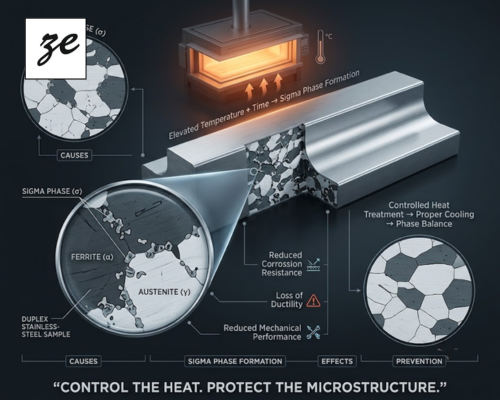
Sigma phase is a hard, brittle intermetallic compound that can form in duplex and super duplex stainless steels when the material remains within a certain elevated-temperature range for too long. It is particularly associated with chromium- and molybdenum-rich regions of the steel.
Duplex stainless steel normally contains a balanced mixture of ferrite and austenite. This two-phase structure gives the material its useful combination of strength, toughness, and corrosion resistance. The problem begins when prolonged exposure to elevated temperatures allows sigma phase to precipitate, mainly from the ferritic phase.
This is why temperature control is so important during welding, forging, heat treatment, and other manufacturing operations.
What Causes Sigma Phase Formation in Stainless Steel?
The main sigma phase formation causes in stainless steel are excessive temperature exposure and insufficient cooling through the temperature range where sigma precipitation can occur.
Several manufacturing conditions can increase the risk:
1. Prolonged Exposure to High Temperatures
Sigma phase can form when duplex stainless steel spends too much time at temperatures where precipitation is thermodynamically favorable. The exact precipitation behavior depends on the grade, chemical composition, thermal history, and cooling rate.
Super Duplex grades, because of their higher chromium and molybdenum contents, require particularly careful thermal control.
2. Incorrect Welding Parameters
Welding creates localized heating. If heat input is too high or interpass temperatures are not properly controlled, the heat-affected zone can experience undesirable phase transformations.
For example, a large welded piping system may look visually perfect after fabrication, but improper thermal control can still affect its internal microstructure and performance.
3. Slow Cooling
Slow cooling gives sigma phase more time to form. Duplex stainless steel components should therefore be cooled appropriately after high-temperature processing rather than being held unnecessarily at intermediate temperatures.
4. Repeated Heating Cycles
Multiple welding repairs, repeated thermal treatments, or uncontrolled reheating can increase the total thermal exposure of the material. This is especially important for critical components where dimensional or fabrication corrections require additional heating.
What Are the Effects of Sigma Phase?
The duplex stainless steel sigma phase effects can be significant because sigma is extremely hard and brittle compared with the desired duplex microstructure.
One major concern is reduced toughness. A component that originally had a useful combination of strength and ductility may become more brittle after excessive sigma precipitation.
Corrosion resistance can also deteriorate. Sigma formation consumes chromium and molybdenum from nearby areas, potentially creating regions with reduced corrosion resistance. This can increase susceptibility to localized corrosion.
Mechanical performance may also suffer. Excessive sigma phase can reduce ductility and impact toughness, making a component less suitable for applications involving shock, vibration, pressure fluctuations, or demanding service conditions.
For example, consider a duplex steel pipe used in a seawater system. The material may have excellent chloride corrosion resistance when its microstructure is properly controlled. If excessive sigma phase develops during fabrication, the finished pipe may no longer provide the same level of expected performance.
How Can Sigma Phase Be Prevented?
Effective sigma phase prevention in duplex stainless steel begins with controlling the entire manufacturing process, rather than trying to correct problems after production.
Use the Correct Heat Treatment
A suitable solution annealing treatment followed by rapid cooling is commonly used to restore the desired duplex microstructure after appropriate processing. The exact temperature and cooling requirements depend on the specific grade and applicable material standard.
This is why heat treatment should always follow the manufacturer's technical requirements rather than using one temperature schedule for every duplex grade.
Control Welding Heat Input
Welding procedures should be qualified for the particular duplex or super duplex grade. Heat input, interpass temperature, travel speed, shielding gas, and cooling conditions should all be controlled.
For critical projects, weld procedure qualification and appropriate inspection provide additional confidence that the required microstructure and mechanical properties have been maintained.
Avoid Unnecessary Thermal Exposure
Fabricators should avoid holding duplex stainless steel at elevated temperatures longer than necessary. Repeated heating should also be minimized wherever practical.
Buy Material With Proper Certification
Material traceability is another important part of quality control. Buyers should request appropriate mill test certificates and verify that the supplied material meets the specified grade and standard.
Zeon Exports supplies duplex and super duplex products including Alloy 2205 Round Bars, Duplex Steel Sheets & Plates, and Alloy 2205 Pipes & Tubes, with material documentation and traceability supporting industrial procurement requirements.
Why Sigma Phase Control Matters Across Different Products
Sigma phase control is not limited to one type of duplex component. It matters across the complete supply chain.
For example, Duplex Steel Flanges must maintain suitable mechanical and corrosion properties because they form important connections in pressurized piping systems. Similarly, Duplex Steel Fittings may undergo forming and fabrication operations where thermal history needs careful management.
In applications requiring bolted connections, Duplex Steel Fasteners require controlled manufacturing because excessive heating during forging can affect their metallurgical condition. Duplex fastener production specifically requires careful temperature control during forging.
For process-control applications, Alloy 2205 Industrial Valves are used where strength and corrosion resistance are important. Structural applications can also use Super Duplex Steel Structural Profiles, particularly where high strength and corrosion resistance are required.
Duplex Stainless Steel Heat Treatment to Prevent Sigma Phase
Duplex stainless steel heat treatment to prevent sigma phase generally focuses on restoring a balanced austenite-ferrite structure and avoiding prolonged exposure to harmful temperature ranges.
Solution annealing is commonly performed at a sufficiently high temperature to dissolve undesirable precipitates, followed by rapid cooling. However, the correct parameters vary between grades such as 2205, 2507, and other duplex alloys.
Heat treatment should therefore be based on the material specification, product form, applicable ASTM/ASME or other project requirements, and the manufacturer's qualified procedure.
The key principle is simple: heat duplex stainless steel correctly, avoid unnecessary time at critical temperatures, and cool it quickly and appropriately.
How Zeon Exports Supports Duplex Steel Requirements
Zeon Exports is a supplier of Duplex Steel and Super Duplex Steel products for demanding industrial applications. Its product range includes round bars, sheets and plates, pipes and tubes, structural profiles, fasteners, fittings, flanges, and industrial valves. The company also highlights quality assurance, material traceability, technical support, and inspection support for industrial customers.
For buyers working on oil and gas, marine, chemical, desalination, power, or fabrication projects, selecting the correct grade is only the first step. Manufacturing history, heat treatment, welding procedures, inspection, and documentation all contribute to the final performance of duplex stainless steel.
Frequently Asked Questions
Q1. What is sigma phase in duplex stainless steel?
Sigma phase is a hard and brittle intermetallic phase that can precipitate during prolonged exposure to certain elevated temperatures. Excessive formation can reduce toughness, ductility, and corrosion resistance.
Q2. Why is sigma phase harmful to duplex stainless steel?
Sigma phase can make the material more brittle and can reduce localized corrosion resistance by changing the surrounding chromium- and molybdenum-rich regions.
Q3. What causes sigma phase formation?
The primary causes include prolonged exposure to critical temperature ranges, excessive welding heat input, slow cooling, repeated heating cycles, and unsuitable heat-treatment practices.
Q4. How can sigma phase be prevented?
Proper solution annealing, rapid and controlled cooling, qualified welding procedures, controlled heat input, appropriate interpass temperatures, and minimizing unnecessary thermal exposure are key preventive measures.
Q5. Can heat treatment remove sigma phase?
A suitable solution annealing treatment can dissolve unwanted precipitates and help restore the desired duplex microstructure when performed correctly. The exact treatment depends on the grade and applicable specification.
Choose the Right Duplex Steel With Zeon Exports
Sigma phase is a metallurgical issue that should be addressed during material selection, manufacturing, welding, and quality inspection—not after a component fails in service. With proper thermal control and qualified processing, duplex and super duplex stainless steels can deliver the high strength and corrosion resistance expected from these advanced alloys.
For duplex and super duplex steel requirements, contact Zeon Exports for product availability, specifications, technical assistance, and project-based supply support.
- Address: A-7/9, Saboo Building, Ardeshir Dady Cross Lane, Cawasji Patel Tank Road, Mumbai – 400004
- Phone: +91 98205 33105
- Email: sales@zeonexports.com
- Website: www.zeonexports.com