


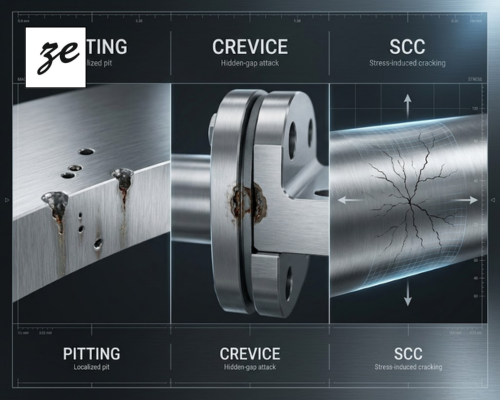
Pitting vs Crevice Corrosion vs Stress Corrosion Cracking: Key Differences
When industrial equipment operates in seawater, chemical processing, oil and gas, desalination, or other demanding environments, corrosion is more than a surface concern. Certain forms of corrosion can begin in small areas and gradually affect the reliability, strength, and service life of critical components. Three important types are pitting corrosion, crevice corrosion, and stress corrosion cracking (SCC).
Although they are all associated with material degradation, they develop in different ways. Understanding pitting vs crevice corrosion and how both differ from stress corrosion cracking can help engineers and procurement teams select suitable materials and reduce unexpected maintenance.
For demanding applications, duplex and super duplex stainless steels are often considered because their balanced ferritic-austenitic structure provides high strength and strong resistance to localized corrosion and SCC. Zeon Exports supplies Duplex Steel and Super Duplex Steel in forms including round bars, sheets, plates, pipes, tubes, flanges, fittings, fasteners, valves, and structural profiles.
What Is Pitting Corrosion?
Pitting corrosion is a localized form of corrosion that creates small cavities or pits on a metal surface. It commonly develops when the protective passive film on stainless steel is locally damaged, particularly in chloride-containing environments.
The difficult part is that pitting can appear relatively small on the surface while becoming deeper below it. In an industrial pipe carrying seawater, for example, a small localized pit may gradually penetrate deeper into the wall and eventually threaten pressure integrity.
Chlorides, stagnant conditions, high temperatures, and an unsuitable material grade can increase the risk. Duplex and super duplex steels are widely selected for applications where resistance to chloride-induced pitting is important. Zeon Exports notes that duplex steel provides very good resistance to pitting and crevice corrosion, while super duplex grades offer enhanced performance in aggressive environments.
For projects requiring corrosion-resistant raw materials, Duplex Steel Round Bars can be used for machined components, shafts, and other applications where strength and corrosion resistance are important.
What Is Crevice Corrosion?
Crevice corrosion occurs in narrow, confined spaces where the environment becomes different from the surrounding exposed surface. Typical locations include underneath washers, gaskets, bolted joints, flange connections, overlapping plates, and poorly drained areas.
The main difference in pitting vs crevice corrosion is the location where corrosion starts. Pitting generally begins at an exposed surface location, whereas crevice corrosion develops inside a restricted gap.
Imagine a flange connection exposed to seawater. The open surface may remain in good condition, but a narrow space underneath a gasket can trap moisture and contaminants. As oxygen becomes depleted inside that space, local electrochemical conditions change and corrosion can accelerate.
This is why correct component selection and good design are important. Super Duplex Steel Flanges are suitable for demanding applications where strength and resistance to aggressive environments are required. Zeon Exports also supplies Super Duplex Steel Fittings for industrial piping applications.
What Is Stress Corrosion Cracking?
Stress corrosion cracking is different because it involves cracking rather than simply localized metal loss. SCC occurs when three conditions come together: a susceptible material, a suitable corrosive environment, and tensile stress.
The stress may come from applied loading, residual manufacturing stresses, welding, forming, or assembly. The environment can include chlorides or other aggressive chemical conditions.
SCC can be particularly concerning because the visible surface may not show extensive corrosion before cracking develops. A component can therefore appear acceptable during a basic visual inspection while a crack is progressing internally.
Duplex steels are known for strong resistance to stress corrosion cracking compared with many conventional austenitic stainless steels. Certain super duplex grades are specifically used in aggressive chloride and offshore environments because of their combination of high strength and corrosion resistance.
Pitting vs Crevice Corrosion vs SCC: The Main Differences
The easiest way to understand the three mechanisms is to consider what causes the damage.
- Pitting corrosion creates localized cavities, usually on an exposed surface, and is strongly associated with chloride exposure and breakdown of the passive layer.
- Crevice corrosion develops inside narrow gaps where stagnant conditions and oxygen depletion create an aggressive local environment.
- Stress corrosion cracking produces cracks when tensile stress and a corrosive environment act on a susceptible material.
These mechanisms can also interact. For example, a localized corrosion site can create a stress concentration, while a poorly designed joint can create both crevice conditions and mechanical stress.
Stress Corrosion Cracking Prevention
Effective stress corrosion cracking prevention starts before fabrication. Engineers should select a material suitable for the expected temperature, chemical environment, chloride concentration, and mechanical loading.
Several practical measures can help:
- Select corrosion-resistant grades such as duplex or super duplex steel where appropriate.
- Reduce unnecessary tensile and residual stresses through proper design and controlled fabrication.
- Use suitable welding procedures and heat-treatment practices where required.
- Avoid unnecessary crevices and stagnant areas in equipment design.
- Maintain clean surfaces and control deposits or contaminants.
- Consider temperature and chloride levels when selecting the material.
- Inspect critical components periodically for early signs of localized corrosion or cracking.
For structural applications exposed to demanding environments, Super Duplex Steel Structural Profiles can provide a useful combination of strength and corrosion resistance.
Similarly, Super Duplex Steel Fasteners can be considered for bolted assemblies where corrosion resistance and mechanical strength are both important.
For process systems, Duplex Steel Pipes & Tubes are used where reliable fluid transport and corrosion resistance are required.
Choosing the Right Material
Material selection should always be based on the actual service environment rather than corrosion resistance alone. Factors such as chloride concentration, temperature, pressure, pH, stress level, fabrication method, and expected service life should be considered.
Super duplex steel, including grades such as Alloy 2507/F53 and F55, provides a high-strength option for particularly aggressive applications. Zeon Exports supplies these materials in multiple product forms and supports industrial requirements across sectors including oil and gas, marine, chemical processing, desalination, power generation, and other demanding industries.
Whether the requirement is for Sheets & Plates, fittings, flanges, fasteners, valves, pipes, or structural materials, selecting the correct grade and specification can make a major difference to long-term performance.
Frequently Asked Questions
Q1. What is the main difference between pitting and crevice corrosion?
Pitting corrosion usually develops as localized cavities on exposed metal surfaces, while crevice corrosion develops inside narrow gaps or confined areas where stagnant conditions cause localized chemical changes.
Q2. Is super duplex steel resistant to pitting corrosion?
Super duplex steel offers excellent resistance to pitting, particularly in chloride-containing environments. Its high chromium, molybdenum, and nitrogen content contributes to its strong localized-corrosion resistance.
Q3. What causes stress corrosion cracking?
SCC generally requires a combination of a susceptible material, tensile stress, and a corrosive environment. Chloride-containing conditions are an important concern for susceptible stainless steels.
Q4. How can crevice corrosion be reduced?
Good design is important. Minimize narrow gaps, prevent stagnant liquid from collecting, use suitable gasket and joint arrangements, maintain clean surfaces, and select a material appropriate for the environment.
Q5. Which is more dangerous: pitting, crevice corrosion, or SCC?
There is no universal answer. Pitting and crevice corrosion can cause significant localized metal loss, while SCC can lead to cracking and sudden loss of component integrity. The actual risk depends on the material, environment, design, and operating conditions.
Contact Zeon Exports
Zeon Exports is a supplier of Duplex Steel & Super Duplex Steel, offering industrial materials for demanding applications and global requirements. Its product range includes round bars, sheets and plates, pipes and tubes, structural profiles, fasteners, fittings, flanges, and industrial valves.
- Address: A-7/9, Saboo Building, Ardeshir Dady Cross Lane, Cawasji Patel Tank Road, Mumbai – 400004
- Phone: +91 98205 33105
- Email: sales@zeonexports.com
- Website: www.zeonexports.com
For material requirements, specifications, and export enquiries, contact Zeon Exports to discuss the appropriate Duplex or Super Duplex Steel solution for your application.