


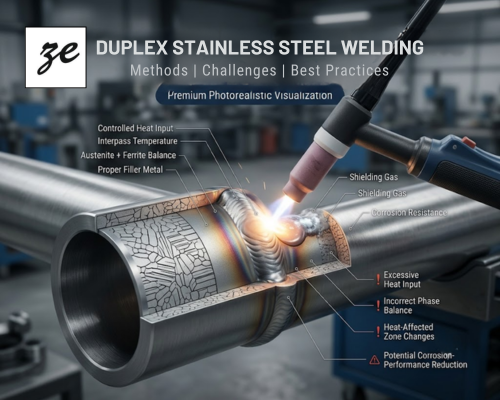
Duplex Stainless Steel Welding: Methods, Challenges & Best Practices
Duplex stainless steel is widely used in industries where high strength, corrosion resistance, and long service life are essential. It is particularly valuable in oil and gas, chemical processing, marine, desalination, power generation, and fabrication applications. However, welding this material requires more control than welding conventional stainless steels.
The reason is simple: duplex stainless steel contains both ferritic and austenitic phases. The welding process must preserve a suitable balance between these two phases so the finished joint maintains the required mechanical and corrosion-resistant properties. Zeon Exports, a Supplier of Duplex Steel & Super Duplex Steel, supports industrial requirements with products and material solutions for demanding applications.
Why Is Duplex Stainless Steel Welding Different?
The two-phase structure gives duplex stainless steel its excellent combination of strength and corrosion resistance. Grades such as Alloy 2205 and Super Duplex grades such as Alloy 2507 are designed to perform in aggressive environments.
During welding, however, the heat can change the phase balance and affect the properties around the weld. Excessive heat input or an unsuitable cooling rate may encourage excessive ferrite or undesirable intermetallic phases. This can reduce toughness and corrosion resistance.
That is why duplex stainless steel welding needs a controlled procedure, suitable filler metal, appropriate heat input, and careful inspection.
Common Duplex Stainless Steel Welding Methods
Several welding processes can be used depending on the material thickness, component design, application, and project requirements.
1. Gas Tungsten Arc Welding (GTAW/TIG): TIG welding provides excellent control over the welding arc and heat input. It is commonly selected for root passes, thin sections, and applications where weld appearance and precision are important.
For pipe fabrication, TIG can provide a clean and controlled root when the correct shielding and purging arrangements are used. The welding procedure should specify suitable current, travel speed, shielding gas, and interpass temperature.
2. Gas Metal Arc Welding (GMAW/MIG): GMAW is useful for higher productivity, particularly when welding larger components. Proper filler metal selection and shielding gas control are important to achieve consistent weld quality.
The process can be suitable for fabrication involving Duplex Steel Pipes & Tubes, structural components, and other industrial assemblies.
3. Shielded Metal Arc Welding (SMAW): SMAW is widely used for repair work, field fabrication, and applications where portability is important. Electrodes specifically designed for duplex grades should be selected according to the approved welding procedure.
Moisture control is also important because electrodes must be stored and handled according to the manufacturer's recommendations.
4. Submerged Arc Welding (SAW): For thick sections and long welds, SAW can offer high deposition rates and good productivity. However, heat input needs careful control. A welding procedure should be qualified for the specific grade, thickness, joint design, and service requirements.
Key Challenges in Duplex Stainless Steel Welding
One of the biggest challenges is maintaining the correct phase balance. If the weld cools too quickly, there may be excessive ferrite. If heat input is too high or cooling is too slow, other metallurgical problems may develop.
Another concern is corrosion performance. Duplex stainless steel is often selected because it must withstand chloride-containing or otherwise aggressive environments. Poor welding practices can reduce the corrosion resistance of the joint even when the base material itself has excellent properties.
Distortion can also become a concern during fabrication. Proper joint preparation, controlled welding sequences, suitable restraint, and careful heat management can help minimize dimensional problems.
For fabricated systems, components such as Duplex Steel Flanges and Duplex Steel Fittings must also be compatible with the selected piping and welding procedure.
Duplex Stainless Steel Welding Best Practices
A reliable welding procedure begins before the first arc is struck. Material identification should be confirmed, and surfaces should be clean and free from oil, grease, moisture, and other contaminants.
- Control heat input. Excessive heat can negatively affect the microstructure. At the same time, cooling must not be so rapid that the desired phase balance cannot develop.
- Maintain interpass temperature. The approved welding procedure should define an appropriate maximum interpass temperature for the grade and application.
- Use the correct filler metal. Filler selection should be based on the base-metal grade, service conditions, welding process, and applicable standards.
- Protect the root properly. For pipe welding, adequate inert-gas purging can help prevent oxidation and maintain root quality.
- Avoid unnecessary reheating. Multiple passes should be planned carefully so that accumulated heat does not adversely affect the weld zone.
- Follow qualified welding procedures. Welding Procedure Specifications (WPS) and Procedure Qualification Records (PQR) should be prepared and qualified where required by the applicable code or project specification.
- Inspect the completed weld. Visual inspection, dimensional checks, and suitable non-destructive testing may be required depending on the application. For critical projects, additional metallurgical or corrosion-related testing may also be specified.
These practices become especially important when fabricating pressure piping, process equipment, offshore systems, or assemblies using Super Duplex Steel Pipes & Tubes.
Choosing the Right Material Before Welding
Good welding starts with correct material selection. Alloy 2205 is a popular duplex grade for applications requiring a balance of strength and corrosion resistance, while Super Duplex grades such as Alloy 2507 are selected for more severe environments.
The material form also matters. Depending on the project, a fabrication package may include Duplex Steel Round Bars, Sheets & Plates, pipes, fittings, flanges, and Fasteners. For demanding structures, Super Duplex Steel Structural Profiles can also be considered. Duplex Steel Industrial Valves are another important component in process and piping systems.
Selecting compatible materials across the entire assembly helps reduce problems during fabrication, installation, and service.
Duplex Stainless Steel Welding Services and Material Support
A successful project is not only about having a skilled welder. It also depends on material traceability, correct specifications, suitable filler metals, qualified procedures, inspection requirements, and proper documentation.
Zeon Exports supplies Duplex and Super Duplex Steel products for industrial applications and provides technical support, documentation, and material selection assistance. The company maintains products in grades including Alloy 2205, Alloy 2304, Alloy 329, Alloy 2507/F53, Alloy 2507/F55, and Alloy 255.
For customers planning duplex stainless steel welding services, working with a reliable material supplier can make procurement and fabrication planning easier.
Frequently Asked Questions
Q1. Is duplex stainless steel difficult to weld?
Duplex stainless steel can be welded successfully, but it requires better control of heat input, cooling, filler metal, shielding, and interpass temperature than many conventional stainless steels.
Q2. What are the main duplex stainless steel welding methods?
Common duplex stainless steel welding methods include TIG/GTAW, MIG/GMAW, SMAW, and SAW. The appropriate process depends on thickness, component design, productivity requirements, and the approved welding procedure.
Q3. Why is heat control important when welding duplex steel?
Heat control helps maintain the required austenite-ferrite balance and protects the mechanical and corrosion-resistant properties of the finished joint.
Q4. Can Alloy 2205 be welded?
Yes. Alloy 2205 has good weldability when appropriate procedures, filler metals, shielding, heat input, and interpass temperature controls are followed.
Q5. What should be checked after duplex stainless steel welding?
The finished weld may require visual inspection, dimensional checks, and non-destructive testing such as dye penetrant, radiographic, or ultrasonic examination, depending on the applicable code and project requirements.
Choose Zeon Exports for Duplex & Super Duplex Steel
When a project involves aggressive environments, pressure systems, offshore equipment, or critical fabrication, material quality and welding control go hand in hand. Choosing the right grade, maintaining a qualified procedure, controlling heat, and inspecting the completed joint can help achieve reliable long-term performance.
Zeon Exports supplies Duplex Steel and Super Duplex Steel products for global industrial requirements, supported by material documentation, technical assistance, and extensive product availability.
- Address: A-7/9, Saboo Building, Ardeshir Dady Cross Lane, Cawasji Patel Tank Road, Mumbai – 400004
- Phone: +91 98205 33105
- Email: sales@zeonexports.com
- Website: www.zeonexports.com