


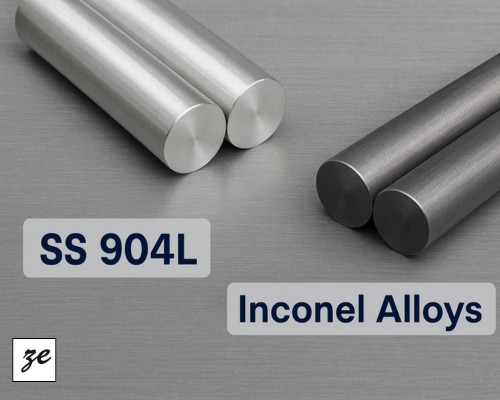
SS 904L vs Inconel Alloys: Which Alloy Is Right for Your Application?
Choosing the correct high-performance alloy is one of the most important decisions in engineering and industrial manufacturing. Among the most trusted materials worldwide, SS 904L and Inconel alloys stand out for their exceptional strength, corrosion resistance, and durability in extreme environments. However, both materials offer different advantages, so the question becomes: SS 904L vs Inconel Alloys: Which Alloy Is Right for Your Application?
Understanding SS 904L
SS 904L is a super austenitic stainless steel known for its high nickel and molybdenum content. This unique chemistry makes it far more corrosion-resistant than standard stainless steels like 316L.
Key benefits of SS 904L include:
- Excellent resistance to sulphuric acid, phosphoric acid, and chloride environments
- Higher durability than conventional stainless steels
- Good weldability and formability
- Cost-effective compared to nickel-based superalloys
Its combination of affordability and performance makes SS 904L widely used in chemical processing plants, seawater handling, and pollution-control equipment.
Understanding Inconel Alloys
Inconel is a family of nickel-chromium-based superalloys designed for severe environments. Grades like Inconel 625 and Inconel 718 offer unmatched strength even at temperatures exceeding 1,000°C.
Key advantages of Inconel alloys:
- Exceptional high-temperature strength
- Outstanding resistance to oxidation and carburization
- Superior corrosion resistance in both acidic and alkaline environments
- High fatigue, creep, and stress-rupture resistance
Because of these properties, Inconel alloys are indispensable in aerospace, oil & gas, turbine components, nuclear facilities, and high-temperature processing.
SS 904L vs Inconel Alloys: Which Alloy Is Right for Your Application?
Choosing between SS 904L and Inconel requires understanding the conditions your equipment will face. Below is a detailed comparison that makes your decision easier.
1. Composition & Material Strength
SS 904L contains:
- High nickel (23–28%)
- Molybdenum (4–5%)
- Low carbon levels
This composition boosts corrosion resistance but keeps costs lower than nickel superalloys.
Inconel alloys, especially grades like 625 or 718, contain:
- Nickel above 50%
- Chromium 20–23%
- Additional elements like titanium, niobium, and cobalt
This gives Inconel unmatched strength and performance under heat and extreme stress.
Conclusion: If you require maximum strength and temperature stability, Inconel is superior. For moderate corrosion and good mechanical stability, SS 904L is ideal.
2. Corrosion Resistance
When comparing SS 904L vs Inconel Alloys: Which Alloy Is Right for Your Application?, corrosion resistance is a critical factor.
- SS 904L performs exceptionally well in chloride-rich and acidic conditions, especially in sulphuric acid.
- Inconel alloys offer broader corrosion resistance and withstand harsh chemicals, oxidizing environments, and extreme pH variations.
If your equipment comes in contact with seawater, acids, or corrosive gases at high temperatures, Inconel performs better.
3. Temperature Resistance
- SS 904L is stable up to about 400–450°C.
- Inconel alloys maintain strength up to 1,000°C or more.
This is why Inconel is widely used in jet engines, furnaces, heat exchangers, and gas turbines.
4. Cost Difference
Cost often becomes a deciding factor.
- SS 904L is significantly more affordable.
- Inconel alloys are expensive due to their high nickel content and advanced performance characteristics.
For budget-sensitive applications, SS 904L gives excellent value. For critical, safety-dependent components, Inconel is worth the investment.
5. Applications Overview
SS 904L is preferred in:
- Chemical processing equipment
- Heat exchangers
- Pulp & paper industry
- Seawater piping
- Pharmaceuticals
- Food processing plants
Inconel alloys are used in:
- Aerospace components
- Gas turbines
- High-temperature furnace parts
- Nuclear reactors
- Oil & gas exploration
- Marine engineering
- Chemical industries requiring extreme corrosion resistance
Which Alloy Is Right for Your Application?
Both materials are exceptional, but they serve different purposes.
Choose SS 904L if you need:
- High corrosion resistance
- Lower cost
- Good performance in moderate temperatures
- Long service life in chemical and marine uses
Choose Inconel alloys if you need:
- Maximum high-temperature strength
- Extreme corrosion resistance
- Performance under heavy mechanical stress
- Materials for mission-critical applications
At Zeon Exports, we supply premium-quality SS 904L and multiple Inconel grades, ensuring every client gets the right material for their engineering needs. Our products meet global standards and deliver long-term performance and reliability.
FAQs
1. Which is more corrosion-resistant: SS 904L or Inconel?
Inconel alloys generally offer higher corrosion resistance, especially in extreme environments. SS 904L performs very well in acidic and chloride-rich conditions.
2. Is SS 904L suitable for high-temperature applications?
SS 904L works well up to around 450°C. For temperatures above this, Inconel is the better choice.
3. Why is Inconel more expensive?
Inconel contains over 50% nickel and rare alloying elements, making it a premium high-performance material.
4. Can SS 904L replace Inconel in chemical industries?
For moderate corrosion environments, yes. For extreme acids or high temperatures, Inconel is recommended.
5. Does Zeon Exports supply both materials?
Zeon Exports offers SS 904L, Inconel 600, Inconel 625, Inconel 718, and other high-grade alloys globally.